Horse Racing Betting Odds: The Complete UK Guide
 Available in US
Compare. Calculate. Bet Smarter.
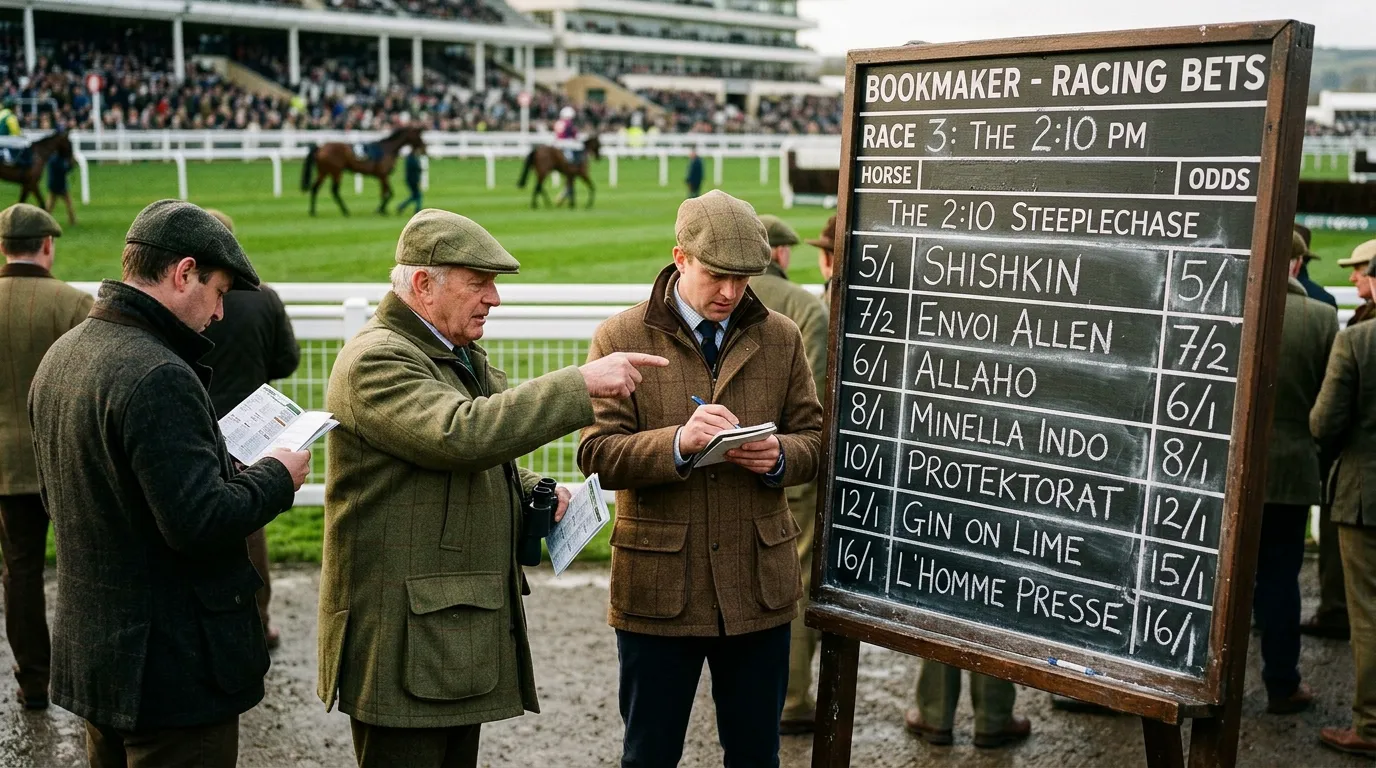
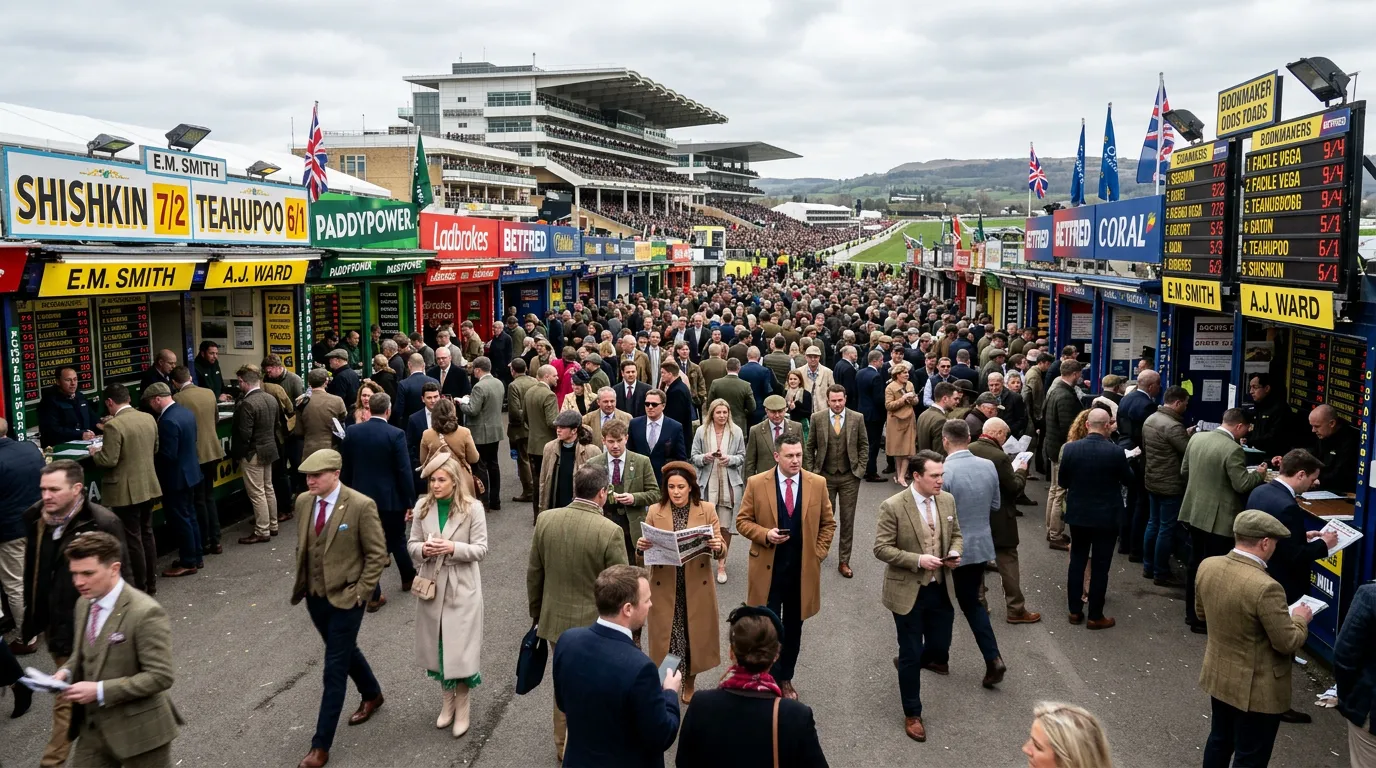
Horse racing betting odds represent the language every serious punter must learn to speak fluently. Stand at Cheltenham on Gold Cup day, boards flashing with figures like 7/2, 4/1, and 15/2, and you're watching a conversation between bookmakers and bettors unfold in real time. Those numbers tell you precisely what you stand to win from your stake—and, more importantly, what the market believes about each horse's chances of victory.
UK horse racing betting operates within an industry generating £12.6 billion in gross gambling yield for the financial year ending March 2025, according to the Gambling Commission. Racing commands a substantial portion of that figure, particularly during the major festivals that punctuate the calendar. The British Horseracing Authority reports that racecourse attendance reached 5.031 million in 2025—the first time since 2019 that figure has exceeded five million—demonstrating the enduring appeal of the sport to British punters.
This guide isn't about tipping winners or ranking bookmakers. It's about building the foundational knowledge that separates punters who understand their bets from those who simply hope for the best. Making sense of horse racing odds means understanding implied probability, recognising value when bookmaker margins create opportunities, and knowing why a horse drifting from 5/1 to 8/1 might represent either danger or opportunity depending on context.
Whether you place your bets trackside, through a high street shop, or via one of the many mobile apps that now handle over 80% of major festival wagers, the underlying mathematics remain consistent. The numbers may appear in fractional form—the traditional British presentation—or decimal format favoured by exchanges and international markets. The principles of making sense of horse racing odds apply regardless of format, and this guide will equip you to navigate both.
Race Betting Slip
What Separates Informed Punters From Hopeful Ones
- Horse racing odds represent bookmaker probability assessments plus built-in margin—understanding the overround helps identify when prices genuinely offer value versus simply covering the house edge.
- The favourite-longshot bias is real: academic studies show returns plummet at higher odds, with selections above 18/1 historically returning just 28p per pound staked.
- Major festivals create unique opportunities: Cheltenham 2026 expects £450 million in UK turnover, with competitive bookmaker pricing making genuine value more available.
- Systematic odds comparison across multiple bookmakers compounds significantly—small percentage differences on consistent bets translate to substantial annual gains.
- Responsible gambling tools from licensed operators protect your betting sustainability; unlicensed sites have grown 522% in UK traffic but offer no consumer safeguards.
How Horse Racing Odds Work in the UK
Every set of racing odds represents a bookmaker's assessment of probability, adjusted to ensure they maintain an edge regardless of outcome. When a horse is priced at 4/1, the bookmaker is signalling roughly a 20% chance of that horse winning—but that figure includes their built-in margin, the overround that keeps betting shops in business and racecourses funded through the levy system.
The mechanics work straightforwardly once you understand the underlying logic. A bookmaker analyses every runner in a race: recent form, trainer statistics, jockey bookings, ground conditions, distance suitability, and dozens of other factors. They assign each horse a probability of winning, then convert those probabilities into prices that collectively exceed 100%. That excess—typically 10-20% for British horse racing—constitutes the overround, sometimes called the vig or juice in other markets.
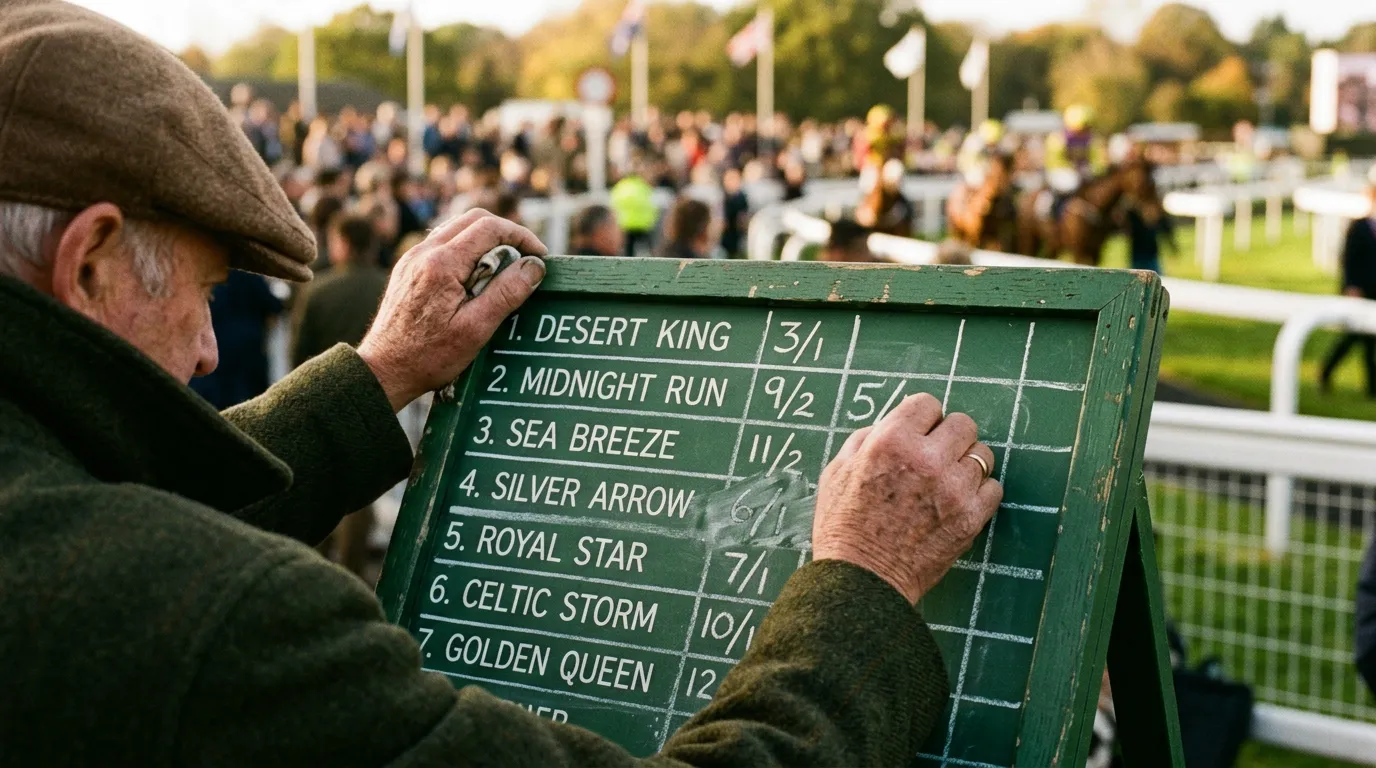
Implied Probability — The percentage chance of an outcome suggested by the betting odds. Calculate it by dividing 1 by the decimal odds (or by dividing the denominator by the sum of numerator and denominator for fractional odds). A 4/1 shot implies roughly 20% probability; a 1/2 favourite implies roughly 67%.
Consider a six-runner race where the bookmaker prices horses at evens (50%), 3/1 (25%), 5/1 (16.7%), 8/1 (11.1%), 12/1 (7.7%), and 20/1 (4.8%). Those implied probabilities sum to approximately 115%, meaning the bookmaker has built in a 15% overround. In reality, of course, probabilities must sum to exactly 100%—one horse will win—but bookmakers price above certainty to guarantee their margin.
Odds movement reveals market sentiment in real time. When a horse's price shortens—from 6/1 to 4/1, for instance—money is flowing toward that selection, whether from shrewd professional punters, insider knowledge, or simply public enthusiasm. The reverse movement, a horse drifting from 4/1 to 7/1, typically indicates reduced confidence in the runner's chances. According to data from the Horserace Betting Levy Board, average turnover per race declined 8% in the 2024/25 season compared to the previous year—and 19% compared to 2021/22—meaning individual wagers now carry more weight in smaller pools, potentially amplifying price movements.
Understanding these dynamics proves essential because odds don't simply predict outcomes—they shape them. Professional bettors watch for overreactions: a horse drifting excessively on a poor rumour might represent value if the fundamental assessment remains sound. Conversely, a heavily backed horse might shorten to a price that no longer offers sufficient return relative to actual probability.
The transition from retail to digital betting has reshaped how odds form. The Social Market Foundation reports that remote gambling's share of the UK market has grown from 15% to 60% over the past eleven years. This shift means prices now respond more rapidly to information, with betting exchanges providing real-time liquidity that traditional on-course betting rings could never match. For punters willing to understand the mechanism behind the numbers, this market efficiency creates both challenges and opportunities.
Odds represent bookmaker probability assessments plus their profit margin. Understanding the overround helps identify when prices might offer genuine value versus when you're simply paying the house edge.
Fractional, Decimal and American: Making Sense of Odds Formats
Walk into any British racecourse or high street betting shop and you'll encounter fractional odds—the traditional notation that has defined UK racing for generations. These familiar expressions, 5/1 (spoken as "five-to-one"), 7/2 ("seven-to-two"), or 11/8 ("eleven-to-eight"), represent the profit you'll receive relative to your stake. A £10 bet at 5/1 returns £50 profit plus your original £10 stake, totalling £60. The format persists in British racing culture despite its occasional complexity because it speaks to racing's heritage and remains the default language of trackside bookmakers.
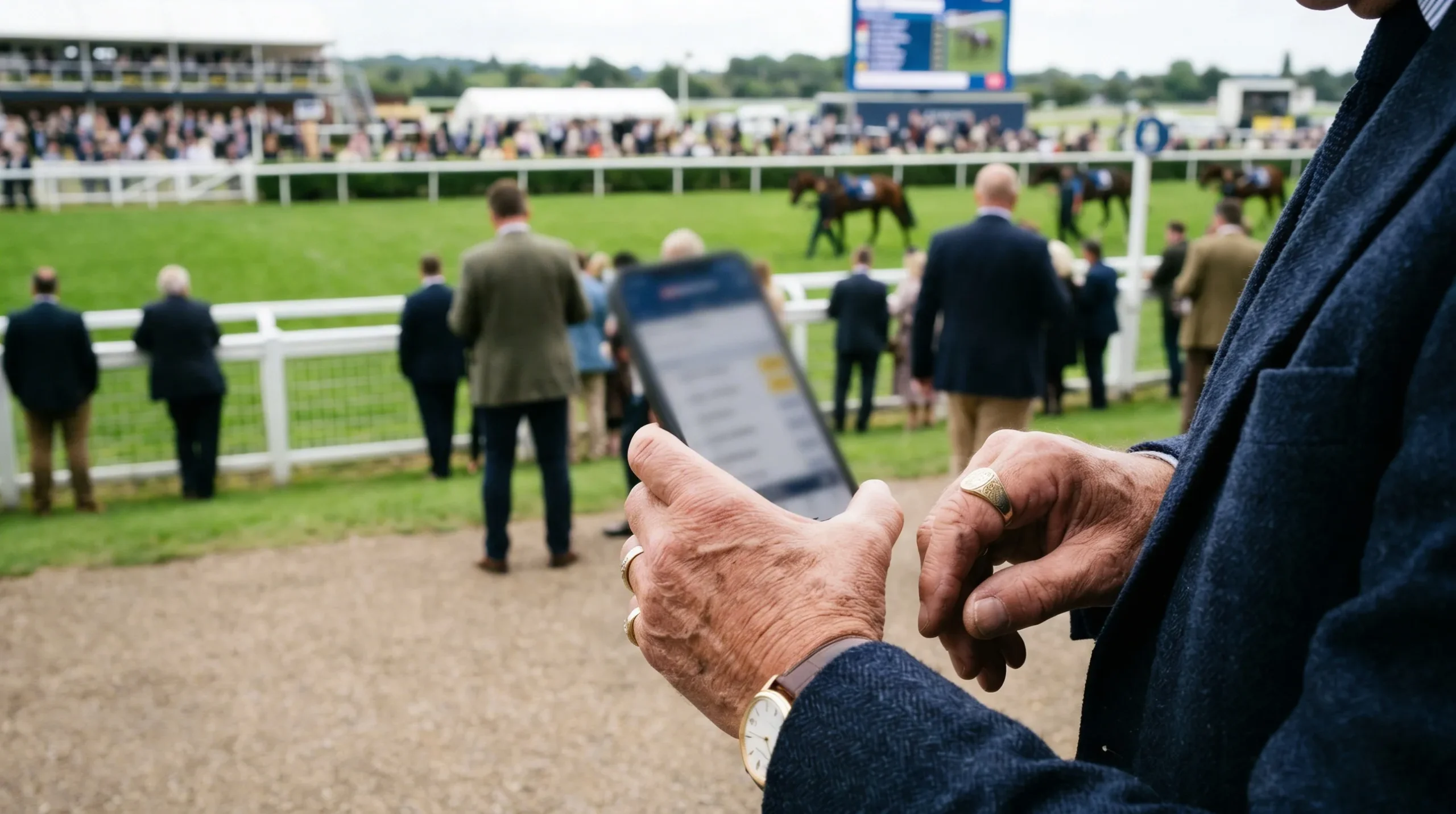
Decimal odds, meanwhile, have become increasingly dominant in digital betting environments. When more than 80% of Cheltenham Festival 2024 wagers were placed via mobile devices, punters predominantly encountered decimal formats on their screens. The appeal is simplicity: decimal odds show your total return including stake, eliminating the mental arithmetic required with fractions. That same 5/1 becomes 6.00 in decimal—multiply your stake by 6.00 to see your total return. No addition required.
| Fractional Odds | Decimal Odds | Implied Probability | £10 Stake Returns |
|---|---|---|---|
| 1/5 | 1.20 | 83.3% | £12.00 |
| 1/2 | 1.50 | 66.7% | £15.00 |
| Evens | 2.00 | 50.0% | £20.00 |
| 2/1 | 3.00 | 33.3% | £30.00 |
| 5/1 | 6.00 | 16.7% | £60.00 |
| 10/1 | 11.00 | 9.1% | £110.00 |
| 25/1 | 26.00 | 3.8% | £260.00 |
American odds appear less frequently in UK markets but merit understanding for international betting or certain exchange platforms. Positive American odds show profit on a £100 stake (+500 means £500 profit from £100), while negative odds show how much you must stake to win £100 (-200 means stake £200 to profit £100). British punters rarely need American format for domestic racing, but exposure through global betting platforms makes familiarity worthwhile.
Converting Fractional to Decimal
Step 1: Divide the first number by the second (e.g., 5/1 = 5 ÷ 1 = 5)
Step 2: Add 1 to include your returned stake (5 + 1 = 6.00)
Result: 5/1 fractional equals 6.00 decimal
The format you choose matters less than understanding what the numbers represent. Whether you see 7/2, 4.50, or +350, all three describe the same price—the same implied probability and the same potential return. Betting exchanges typically default to decimal, most betting apps offer format selection, and traditional course bookmakers remain wedded to fractions. Proficient punters think in probabilities first, then translate to their preferred notation.
One practical consideration: fractional odds occasionally present awkward calculations. What's the return on a £7.50 stake at 11/8? Most punters would reach for a calculator. The decimal equivalent, 2.375, makes the arithmetic trivial—multiply and you have your answer (£17.81). For live betting or quick decisions, decimal formats reduce cognitive load, which partly explains their mobile dominance. Yet format fluency is only the first step—interpreting what those prices mean for your betting decisions requires deeper understanding.
How to Read UK Racing Odds Like a Professional
Reading racing odds professionally means seeing beyond the numbers to the market story they tell. The favourite, marked with the shortest price, represents the collective market judgment on the most likely winner. But odds-on favourites—horses priced below evens, such as 1/2 or 4/9—require particular scrutiny. Backing such short prices demands exceptional confidence because you're risking more than you stand to win, and even heavily fancied horses lose regularly enough to erode bankrolls quickly.
Outsiders and longshots occupy the other end of the market, tempting punters with substantial potential returns for modest stakes. A £5 bet on a 33/1 outsider returns £170 when successful—attractive arithmetic until you consider the implied probability suggests that horse wins roughly once in 34 attempts. Somewhere between these extremes lie the mid-range selections where professional punters often focus attention, identifying horses whose actual chances exceed what the odds suggest.
Starting Price (SP) — The official odds at the moment a race begins, determined by on-course bookmaker prices. SP serves as the settlement price when you don't take a fixed price earlier or when Best Odds Guaranteed applies. Taking SP means accepting whatever price the market settles on by race time.
The distinction between early prices and Starting Price shapes much betting strategy. Morning prices, available hours before a race, reflect bookmaker assessments based on form analysis and anticipated market interest. These prices shift throughout the day as money enters the market. A horse might open at 8/1 in the morning and start at 5/1—punters who took the early price secured better value. Conversely, horses can drift significantly if expected support fails to materialise or negative news emerges.
When early prices offer advantage: If you've done your analysis and identified a runner you believe will attract support, taking an early price locks in value before the market contracts. This proves particularly valuable during major festivals when public enthusiasm can dramatically shorten prices on popular horses.
The British Horseracing Authority has noted that high-profile fixtures increasingly attract disproportionate attention from larger staking customers—a trend that influences how prices form at the biggest meetings. This concentration means prices at Cheltenham, Royal Ascot, and Aintree tend to be sharper (lower margins) due to the volumes involved, while midweek cards at smaller tracks may carry higher overrounds.
Best Odds Guaranteed offers protection against taking an early price that subsequently improves. Most major UK bookmakers provide this feature for horse racing: if you take 8/1 in the morning and the SP is 10/1, you receive the better price. Understanding which operators offer BOG, and on which markets, adds practical value to any betting approach. The feature effectively removes downside risk from taking early prices while preserving upside potential—a rare asymmetry worth exploiting.
Watching the market in real time develops intuition for reading odds professionally. Steady shortening throughout the day suggests genuine support; sudden late support might indicate shrewd money or simply public bandwagon effect. Prices drifting without obvious cause merit investigation—perhaps going conditions have changed, a jockey switch has occurred, or paddock inspectors see something concerning. Every price movement contains information, and learning to interpret these signals distinguishes informed punters from recreational bettors.
Bet Types and Their Odds: From Win Bets to Accumulators
Win bets represent the purest expression of horse racing betting: pick a horse, stake your money, and collect if your selection finishes first. The odds quoted are the win odds, and the calculation is straightforward. More complex bet types layer additional structure onto this foundation, each altering the risk-reward profile in ways that suit different circumstances and temperaments.
Each-way betting has become increasingly popular among British punters, with each-way wagers rising 25% at Cheltenham Festival 2024 compared to the previous year. An each-way bet comprises two equal stakes: one backing your horse to win, another backing it to place (typically finish in the top two to four positions, depending on field size and race type). If your horse wins, both parts pay out. If it places but doesn't win, you lose the win stake but collect on the place portion at reduced odds—usually one-quarter or one-fifth of the win price.

Calculating Each-Way Returns
Selection: 10/1, £5 each-way (total stake: £10), place terms: 1/4 odds for places 1-2-3
If horse wins: Win portion returns £50 profit + £5 stake = £55. Place portion at 10/4 (2.5/1) returns £12.50 profit + £5 stake = £17.50. Total return: £72.50
If horse places second: Win portion loses £5. Place portion at 2.5/1 returns £12.50 profit + £5 stake = £17.50. Total return: £17.50 (profit: £7.50)
If horse finishes fourth or worse: Both portions lose. Return: £0
Place-only bets remove the win element entirely, offering lower returns for higher probability of success. These prove particularly relevant in fields where a specific horse seems likely to compete for minor honours without having the class to win outright. Some betting exchanges offer place markets with separate liquidity, allowing punters to back or lay place outcomes independently.
Accumulators combine multiple selections into a single bet, with winnings from each leg rolling onto the next. The appeal lies in potentially transforming modest stakes into substantial returns—four 3/1 winners accumulate to approximately 255/1 (4 × 4 × 4 × 4 = 256 minus stake). The mathematics also illuminate why accumulators favour bookmakers: the probability of four independent events all occurring correctly multiplies rather than adds, making successful four-folds genuinely rare.
Forecast bets require predicting the first two finishers in correct order (straight forecast) or any order (reverse forecast). Tricast bets extend this to the first three. These bets typically settle at a dividend declared after the race rather than at fixed odds, calculated from pool betting totals using a formula that rewards correctly identifying unlikely combinations. A forecast involving two outsiders generates significantly larger dividends than one featuring market leaders.
Exotic bets such as the Tote Placepot (picking placed horses in six designated races) or Scoop6 (selecting winners of six televised races for a jackpot pool) operate entirely through pool betting. Returns depend on total pool size and the number of successful tickets, meaning dividends vary dramatically between meetings. These formats appeal to punters seeking lottery-style outcomes where small stakes might generate life-changing returns, though the probabilities reflect that difficulty.
Choosing between bet types depends on your assessment of each situation. Win bets on genuine fancied runners, each-way coverage on solid each-way profiles in competitive handicaps, strategic accumulators with carefully selected legs—each approach suits different market conditions. The odds may look similar across bet types, but the underlying mathematics create meaningfully different expected values that inform smart selection.
Finding Value: The Key to Profitable Horse Racing Betting
Value betting represents the single most important concept separating profitable punters from those who steadily contribute to bookmaker margins. A value bet exists when the odds offered exceed the true probability of an outcome. If you genuinely believe a horse has a 25% chance of winning but bookmakers price it at 5/1 (implying 16.7%), that gap represents value—and finding such opportunities consistently is the foundation of successful betting.
The challenge, naturally, lies in accurately assessing true probabilities. Bookmakers employ teams of analysts, sophisticated models, and decades of collective experience. The average punter cannot match this institutional expertise across every race. But bookmakers must also price entire meetings efficiently, creating opportunities for punters who specialise—whether in specific courses, race types, trainers, or conditions—to identify mispricings in their area of focus.
Overround (Book Percentage) — The total implied probability of all runners in a race, expressed as a percentage. A fair book would total 100%. British racing typically shows overrounds of 110-120%, meaning bookmakers build 10-20% margin into their prices. Lower overrounds indicate sharper markets; higher overrounds mean more value is extracted from punters collectively.
The favourite-longshot bias presents a systematic inefficiency that academic research has documented extensively. A Management Science study analysing 1.3 million horse starts across 38 British racecourses from 1994 to 2018 confirmed that longshots consistently underperform their implied probabilities, while favourites tend to offer better value relative to their chances. Research from Ziemba and Hausch quantified this further: horses priced between 10/1 and 18/1 historically returned approximately 65 pence per pound staked, while those above 18/1 returned roughly 28 pence—significantly worse than the expected fair return.
65% — average return at 10/1 to 18/1 odds
28% — average return at odds above 18/1
Does this mean always backing favourites? Not quite. As researchers Smith and Vaughan Williams have noted: "The favourite-longshot bias still exists, but it has weakened. Studies showed the bias declining compared to the 1990s, likely due to the rise of online betting, increased market efficiency, and betting exchanges driving sharper odds." Modern markets correct more efficiently than those of decades past, meaning simple rules like "back all favourites" or "never back longshots" oversimplify complex dynamics.
The longshot trap: Recreational punters systematically overestimate longshot chances, attracted by headline prices that promise substantial returns from small stakes. This tendency explains why bookmakers can profitably offer inflated prices on rank outsiders—they know the volume of hopeful small stakes will compensate for occasional large payouts.
Practical value identification requires disciplined assessment. Before checking prices, estimate your own probability for each contender based on form, conditions, jockey, trainer, and relevant factors. Then compare your assessment to market prices. If your analysis suggests 20% probability and the market offers 6/1 (implying 14%), you've potentially found value. If the market offers 4/1 (implying 20%), the price aligns with your assessment and holds no edge.
Track your results over meaningful sample sizes. One hundred bets might show profit due to variance even with no genuine edge, just as a legitimate approach might show losses over short periods. Professional bettors think in thousands of bets, recognising that edge manifests over time rather than in individual wagers. Keeping records that include your assessed probability alongside actual odds and outcomes allows objective evaluation of whether your value judgments prove accurate.
Value exists when odds exceed true probability. Finding it consistently requires specialisation, disciplined probability assessment, and long-term thinking that accepts short-term variance while focusing on the underlying edge.
Why Comparing Bookmakers Matters for Your Bottom Line
The difference between 5/1 and 11/2 on the same horse might seem marginal. But compound that gap across hundreds of bets annually and the impact becomes substantial. Odds comparison isn't just good practice—it's fundamental to extracting maximum value from every wager you place. Bookmakers price independently, their algorithms weighted differently, their liabilities distributed uniquely across their customer bases. This creates pricing variations worth exploiting.
UK punters benefit from a competitive betting market where regulatory frameworks keep operator margins relatively low by international standards. The Social Market Foundation reports that Britain's 21% remote gaming duty rate sits significantly below comparable jurisdictions—Pennsylvania levies 36%, New York 51%, and the Netherlands 37.8%. This regulatory environment allows UK bookmakers to offer sharper odds than their international counterparts, with that benefit flowing to punters who shop around.
The effective Levy rate on British horse racing betting—the mechanism funding the sport through betting turnover—stands at approximately 8.5% of gross gambling yield. By comparison, Australia's Victoria region charges 18.4%, more than double the British rate. Lower extraction from betting turnover means more money stays in the market as competitive odds rather than disappearing into levy contributions.
| Odds Difference | £10 Stake Return Variance | Impact Over 500 Bets |
|---|---|---|
| 5/1 vs 11/2 | £5 difference | £2,500 (assuming 10% win rate) |
| 3/1 vs 7/2 | £5 difference | £2,500 (assuming 10% win rate) |
| 10/1 vs 12/1 | £20 difference | £1,000 (assuming 5% win rate) |
Best Odds Guaranteed policies amplify the benefit of maintaining multiple bookmaker accounts. If you take an early price at one bookmaker offering BOG and the SP proves better, you receive the improved odds automatically. This removes the guesswork from timing decisions—take your price when your analysis suggests value, knowing you'll benefit from any subsequent market improvement without sacrificing early price advantages.
Practical approach: Maintain accounts with at least four to six major bookmakers. Check an odds comparison site before placing any significant bet. Even if the same bookmaker offers the best price more often than not, the occasions when they don't can represent meaningful differences over a season's betting.
Betting exchanges offer an alternative worth considering alongside traditional bookmakers. Because exchanges match punters against each other rather than positioning themselves against customers, they typically offer tighter margins—sometimes significantly so. A horse might be 4/1 with bookmakers but available at 4.5 (9/2 equivalent) on an exchange. The trade-off is commission on winnings, typically 5% on Betfair though reduced through loyalty programmes, plus occasionally thinner liquidity on smaller markets.
For serious punters, odds comparison transitions from occasional practice to systematic habit. Mobile apps make checking multiple prices quick enough that the excuse of inconvenience no longer applies. The cumulative effect of consistently securing the best available price compounds more powerfully than most punters realise, often making the difference between long-term loss and sustainable profit.
Major UK Racing Events: Where the Biggest Odds Opportunities Lie
The Cheltenham Festival in March 2026 commands attention from betting markets worldwide. William Hill estimates that UK betting turnover for the four-day meeting will reach £450 million—a figure that dwarfs typical racing cards and creates unique market dynamics. With this volume comes sharper pricing: bookmakers compete aggressively for large-stake punters, meaning overrounds tighten and genuine value becomes more available for those who've done their homework.
The scale of Cheltenham betting reveals itself in granular data. Flutter Entertainment processed 34.9 million individual bets across the Festival in 2024, an extraordinary figure that underscores how concentrated betting activity becomes during these premier meetings. That concentration benefits informed punters in two ways: markets are liquid enough to accommodate meaningful stakes without moving prices, and the competitive intensity among bookmakers compresses margins.
£450M — expected UK betting turnover for Cheltenham Festival 2026
34.9M — individual bets placed through Flutter at Cheltenham 2024
The Grand National at Aintree represents British horse racing's most democratised betting event. "The Grand National is an integral part of the trading year and traditionally the race that generates the highest turnover," notes Sharon McHugh, Head of Communications at a leading operator. Industry estimates place Grand National turnover above £250 million for the three-day Aintree Festival, with the main race alone generating 700% more bets than the Cheltenham Gold Cup.
This volume has commercial implications punters can exploit. Ante-post markets for the Grand National open months before the race, with fluctuations occurring as the field shapes. Horses withdrawn before declaration forfeit losing ante-post stakes—risk that's priced into longer-range odds through better prices than will be available on race day. Punters comfortable accepting non-runner void risk can lock in value early, though the National's notorious attrition rate through injury and ground concerns makes this a calculated gamble.
Royal Ascot brings different opportunities: flat racing's premier summer meeting features a programme weighted toward quality over quantity, with Group races carrying sufficient prize money to attract international challengers. The global participation complicates form analysis but creates potential edges for punters who follow French, Irish, American, or Australian racing closely enough to assess visitors accurately against domestic form.
Pool betting experiences its highest volumes during major festivals. "It was a very positive week for Britbet and the Tote on course," reported Nigel Roddis, Managing Director of Britbet, following Cheltenham 2025. "We had 467 team members taking bets each day who sold more than 570,000 bets across the week." Tote pool turnover reached a record £11.34 million at Cheltenham 2025—growth of approximately £600,000 despite attendance declining around 5% from the previous year.
Beyond the marquee festivals, the racing calendar offers distinct opportunities throughout the year. The Flat season's spring revival at Newmarket, the York Ebor meeting in August, the St Leger at Doncaster in September—each attracts sufficient betting interest to create competitive markets without the overwhelming volume of Cheltenham or Aintree. Jump racing's autumn resumption through to the spring festivals maintains year-round opportunities, with conditions that favour specialists in soft ground or sharp tracks creating exploitable niches for informed punters.
Ante-post betting deserves particular attention around major events. Prices for the following year's Cheltenham Festival appear within days of each meeting concluding, offering the earliest punters substantial odds on horses that might halve in price by race day. The trade-off—nine to twelve months of injury risk, campaigning decisions, and potential change in competition—is priced into those early odds. Shrewd ante-post betting requires accepting that non-runners will inevitably claim some stakes while banking enough value on survivors to generate long-term profit.
Betting Strategies: Approaches That Work in UK Racing
Effective betting strategies share common foundations regardless of sophistication level: disciplined bankroll management, clear selection criteria, and honest assessment of results. The approach that works best depends on your time commitment, risk tolerance, and willingness to specialise. What follows aren't guaranteed systems—those don't exist—but frameworks that structure decision-making productively.
For punters beginning their journey, concentrating on single bets rather than accumulators builds understanding without complexity. Select one race daily, conduct thorough analysis, and stake a consistent unit amount. This approach limits downside while developing the analytical skills that inform more advanced strategies. Track every bet, including your reasoning at the time of selection, allowing retrospective assessment of whether your logic proved sound even when results disappointed.
Starting a Structured Betting Approach
Step 1: Define your total bankroll—money you can genuinely afford to lose without financial impact.
Step 2: Set unit stakes at 1-2% of bankroll, protecting against inevitable losing runs.
Step 3: Choose a specific focus—race type, distance, course, or trainer—where you'll develop expertise.
Step 4: Record every bet with stake, odds, selection rationale, and outcome.
Step 5: Review monthly: assess strike rate, return on investment, and whether your selection logic holds up.
Specialisation offers edges that generalisation cannot. The punter who follows one trainer's operation closely—understanding their preparation methods, preferred conditions, and typical patterns—will identify opportunities invisible to those scanning entire cards superficially. Similar benefits apply to course specialists, who recognise track idiosyncrasies affecting draw bias, pace dynamics, and horse suitability that casual observers miss.
Intermediate strategies introduce systematic filtering. Rather than assessing every runner, establish criteria that identify your preferred bet types: last-time-out winners stepping up in class, horses returning from layoffs for specific trainers with strong records in such situations, or course-and-distance winners whose odds suggest the market underestimates demonstrated aptitude. These filters reduce decision load while focusing attention where analysis can add value.
Avoiding common mistakes: Chasing losses by increasing stakes after bad runs destroys bankrolls faster than poor selection. Betting every race because the television is on leads to undisciplined punting with negative expectation. Following "hot tips" without understanding the reasoning removes your analytical edge entirely. Discipline matters more than brilliance.
Advanced approaches include Dutching—backing multiple selections in the same race at odds that guarantee profit if any wins—and trading positions through betting exchanges, where you can back at higher odds and lay at lower odds to lock in profit regardless of outcome. These techniques require deeper understanding of market dynamics, reliable access to accurate real-time odds, and willingness to accept lower margins per race in exchange for higher frequency of returns.
Whatever strategy you adopt, realistic expectations matter. Professional punters achieving 10% return on investment over large sample sizes are performing exceptionally well. The 2026 Spring season offers the usual calendar of competitive handicaps and pattern races where disciplined approaches can thrive—but most recreational bettors will still lose over time. The question is whether you lose slowly enough to enjoy the entertainment value, or find an edge sufficient to generate modest but genuine profit. Honest self-assessment prevents the fantasy thinking that leads to damaging losses while enabling sustainable engagement with racing's betting markets.
Responsible Gambling: Keeping Horse Racing Enjoyable
Responsible gambling forms the foundation for sustained enjoyment of horse racing betting. The industry's entertainment value depends on keeping betting under control, treating stakes as the cost of participation rather than expected income. When that balance tips—when betting becomes chasing, when losses prompt larger stakes, when racing feels like obligation rather than pleasure—warning signs demand attention.
The decline in high street betting shops reflects broader shifts in gambling behaviour. The Gambling Commission reports that 5,825 licensed betting premises now operate in Great Britain, marking the eleventh consecutive year of decline. While this trend reflects digital migration rather than reduced betting overall, the closure of physical venues removes one form of social interaction and visible community presence that some bettors valued as informal accountability.

Black market warning: Unlicensed betting sites offer no customer protections. IFHA research documents 522% growth in UK traffic to 22 unlicensed sites offering British racing between August 2021 and September 2024. These sites surpass 600,000 unique monthly visits, yet offer no self-exclusion tools, no deposit limits, and no regulatory oversight. Sticking with licensed UK operators protects both your funds and your access to responsible gambling tools.
Licensed bookmakers offer robust responsible gambling features that punters should configure proactively rather than waiting until problems emerge. Deposit limits cap how much you can add to accounts daily, weekly, or monthly. Loss limits trigger when cumulative losses reach thresholds you've defined. Time-outs temporarily suspend account access when betting feels excessive. Reality checks interrupt sessions with statements of time spent and money wagered—useful circuit breakers against losing track during extended betting.
"Our aim is to prevent the illegal market from operating at scale in Great Britain," states Andrew Rhodes, Chief Executive of the UK Gambling Commission. "A significant part of our strategy in doing that is to target our efforts as far upstream as we can—at the level of hosts, payment providers, software providers, search engines." This regulatory effort protects consumers, but personal responsibility remains essential: use tools available through licensed operators rather than seeking unlicensed alternatives.
GAMSTOP — The free national self-exclusion scheme that registers you with all UK-licensed gambling operators. Once enrolled, you cannot gamble with any licensed site for your chosen period (six months, one year, or five years). Registration is voluntary but irreversible for the selected duration. For punters needing a complete break, GAMSTOP provides the most comprehensive solution available.
Support resources exist for anyone whose betting has become problematic. GambleAware provides free information and counselling referrals. The National Gambling Helpline offers confidential support around the clock. Gamblers Anonymous provides peer support through meetings nationwide. Recognising when betting has crossed from entertainment to difficulty represents strength rather than weakness—and seeking help early prevents minor concerns from escalating into serious problems.
For most punters, responsible gambling simply means treating racing bets as entertainment spending with appropriate limits. Never stake money needed for essential expenses. Don't borrow to bet. Accept that the house edge ensures long-term operator profit unless you've genuinely developed an edge through expertise and discipline. Within these boundaries, horse racing betting adds enjoyment to the sport—the engagement that comes from having an interest in outcomes, the satisfaction of successful analysis, and the community of shared enthusiasm that surrounds British racing.
Horse Racing Odds: Frequently Asked Questions
How do horse racing betting odds work in the UK?
Horse racing odds in the UK show the profit you receive relative to your stake if your selection wins. Fractional odds like 5/1 mean you win £5 for every £1 staked, plus your stake back (totalling £6 return). Decimal odds show total return including stake—the same bet appears as 6.00 in decimal format. Bookmakers set odds by assessing each horse's probability of winning, then building in a margin (overround) that ensures their profit. Odds change throughout the day as money enters the market, with shortened prices indicating increased support and drifting prices suggesting reduced confidence. The Starting Price (SP) is the official final odds when the race begins, used for settlement if you haven't taken an earlier fixed price.
What is the difference between fractional and decimal odds?
Fractional odds (e.g., 5/1, 7/2, 11/8) show profit relative to stake—the traditional British format used by on-course bookmakers and in betting shops. Decimal odds (e.g., 6.00, 4.50, 2.375) show your total return including stake, making calculation simpler by requiring only multiplication. The same odds appear differently in each format: 5/1 fractional equals 6.00 decimal; 1/2 fractional equals 1.50 decimal. To convert fractional to decimal, divide the first number by the second and add one. Most betting apps allow you to select your preferred format, though exchanges predominantly use decimal and traditional course bookmakers remain fractional. Understanding both formats proves valuable since UK punters encounter both regularly.
How do I find value in horse racing odds?
Finding value means identifying bets where the odds exceed the true probability of an outcome. Start by developing your own probability assessment through form analysis before checking prices—this prevents bookmaker odds from anchoring your judgment. If your analysis suggests 20% probability and bookmakers offer 6/1 (implying 14%), that represents value. Specialising in specific trainers, courses, or race types allows deeper expertise than generalists achieve. Compare odds across multiple bookmakers since pricing varies, and consider betting exchanges where margins run tighter. Be aware of the favourite-longshot bias: academic research confirms longshots systematically underperform their implied probabilities, with returns declining sharply at higher odds. Track your results across hundreds of bets to determine whether your value assessments prove accurate over meaningful sample sizes.
Understanding horse racing betting odds transforms how you engage with the sport. From the basic mechanics of fractional and decimal formats to the deeper principles of value identification and market dynamics, this knowledge foundation supports every bet you'll ever place. The numbers on betting boards become meaningful once you see them as probability assessments shaped by market forces—and opportunities emerge where your analysis diverges from bookmaker pricing.
What comes next depends on your ambitions. Recreational punters might focus on enjoying major festivals with informed wagering, using the tools discussed here to make smarter selections without expecting consistent profit. Serious bettors can explore specialisation—developing genuine expertise in narrow domains where deep knowledge generates edges. Either path benefits from the fundamentals covered in this guide.
Successful horse racing betting combines understanding of odds mechanics, disciplined probability assessment, systematic odds comparison, and responsible stake management. Master these foundations and you're equipped to engage with any market, from midweek handicaps to Cheltenham showpieces.
