
Cheltenham Festival Odds: Complete Betting Guide for the Meeting
 Available in US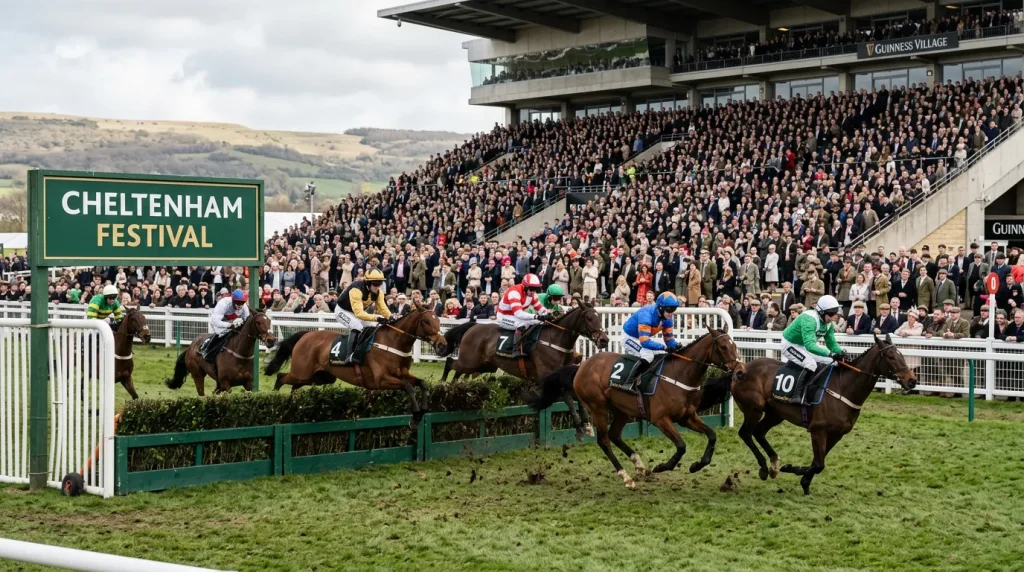
The Festival generates extraordinary betting volume. Projections suggest Cheltenham 2026 will see over £450 million wagered, with Flutter Entertainment alone processing nearly 35 million bets during the 2026 Festival. This liquidity creates opportunities—but also attracts sharp money that compresses value and punishes sloppy analysis.
This guide covers the Festival landscape, approaches to key races, strategic considerations for managing a Festival betting bank, and common mistakes that cost punters money year after year.
Cheltenham Festival Odds — More on this topic at horse racing betting odds.
Cheltenham Festival: The Betting Landscape
The Festival runs Tuesday through Friday in mid-March, with seven races each day. Championship races—the Gold Cup, Champion Hurdle, Queen Mother Champion Chase, and Stayers’ Hurdle—represent the pinnacle of jump racing, attracting the best horses from Britain and Ireland. Supporting races range from novice championships to handicaps, each presenting distinct betting challenges.
Irish-trained horses dominate modern Cheltenham. In recent years, Ireland has won two-thirds or more of Festival races, reflecting the strength of Irish jump racing and the firepower of leading yards. This Irish raider factor shapes betting markets: UK punters often overback British runners from sentiment, while Irish horses frequently offer value despite their dominance.
Market behaviour at Cheltenham differs from typical racing. The combination of enormous betting volume, professional involvement, and concentrated media attention creates markets that are simultaneously efficient and volatile. Morning prices can hold or collapse; steam moves in the final minutes before races are common. Best Odds Guaranteed takes on heightened importance—shorteners are frequent, and BOG protection captures significant value when prices contract.
Ground conditions at Cheltenham vary substantially. The course aims for good to soft, but weather can push conditions toward heavy or dry them toward good. Ground shifts affect race outcomes significantly, rewarding horses suited to prevailing conditions and hampering those who aren’t. Monitoring ground reports throughout the week influences which selections to maintain and which to abandon.
The cumulative intensity of four days’ betting can overwhelm undisciplined punters. Stakes creep upward chasing losses; analysis quality drops as fatigue accumulates; emotional attachment to earlier selections distorts later decisions. Treating the Festival as a marathon rather than a sprint—pacing stakes, accepting variance, maintaining analytical standards—produces better outcomes than lurching from race to race.
Key Races and Betting Angles
The Champion Hurdle opens Tuesday’s racing as the first championship event. Two-mile hurdlers require speed and accuracy, making the race relatively predictable compared to stamina tests. Form translations from earlier season Grade 1s—Fighting Fifth, Christmas Hurdle, Irish Champion Hurdle—provide reliable guidance. The market typically identifies the correct favourite; value lies in identifying when second or third choices are underrated.
The Queen Mother Champion Chase features the best two-mile chasers on Wednesday. The demands are extreme: sustained speed over demanding fences with no margin for error. Horses must combine acceleration with jumping accuracy. Fall rates are elevated; form can be unreliable when one mistake ends a race. Each-way betting captures value when proven horses at bigger prices offer place security.
The Stayers’ Hurdle on Thursday tests stamina over three miles. Pace is typically modest early, quickening progressively. Strong stayers outrun speedier rivals in the final half-mile. Form from long-distance hurdle races—Cleeve Hurdle, Long Walk Hurdle—indicates genuine stayers. Market underestimation of dour stayers creates periodic value.
The Gold Cup on Friday concludes the Festival with the blue riband. Three and a quarter miles over demanding fences, the Gold Cup rewards complete chasers: stamina, jumping, class, and resolution. Recent winners have included established champions returning and improving performers peaking at the right moment. Ante-post markets often compress by race day; catching value early or finding overlooked alternatives at bigger prices represents the Gold Cup opportunity.
Beyond championship races, novice contests—Arkle, Supreme, Ballymore—attract unproven but talented horses whose improvement trajectories can outscore market assessment. Handicaps present lottery conditions: large fields, competitive weights, multiple plausible winners. Place betting and exotic bets suit these races better than outright win backing.
Cheltenham Betting Strategy
Managing a Festival bank requires explicit planning. Decide your total stake allocation before Tuesday; divide it across days and race types rather than betting reactively. Championship races merit stronger staking if you have genuine views; handicaps suit smaller stakes accepting higher variance. Some punters allocate bonus stakes for identified value spots, keeping core allocation conservative.
Ante-post versus on-day represents a key strategic choice. Backing horses months in advance captures bigger prices but carries non-runner risk and denies you Festival-week information. On-day betting incorporates ground reports, market moves, and paddock assessment but typically offers compressed prices. Many successful Festival punters blend both: ante-post positions on strongly fancied horses, on-day flexibility for condition-dependent selections.
Place market value emerges in big-field races. Handicaps with 20+ runners see significant place volatility; horses finishing second through fourth often pay better through place-only betting than each-way treatment suggests. Calculating whether each-way or place-only offers better value for specific horses improves returns in competitive races.
The each-way angle suited Cheltenham betting well—and punters recognised it. Each-way betting popularity rose 25% at the 2026 Festival compared to the previous year, reflecting increased sophistication about place value in large fields. When a horse has genuine win claims but faces multiple plausible rivals, each-way betting captures value that win-only betting leaves exposed.
Liquidity on betting exchanges peaks at Cheltenham, creating trading opportunities for punters comfortable with exchange mechanics. Pre-race positions can be traded in-running; early prices can be locked before moves; lay betting offers ways to oppose overbet selections. Exchange skills add dimensions unavailable through bookmaker-only betting.
Avoiding Cheltenham Betting Mistakes
Over-staking early in the week depletes banks before the Gold Cup. Punters who chase Tuesday losses by Wednesday afternoon often have nothing left for Friday. Pacing stakes across four days, accepting early losses without escalation, and maintaining discipline through variance preserves capital for the meeting’s climax.
Blind Irish bias distorts judgment both ways. Some UK punters dismiss Irish raiders; others overweight them. Neither approach serves analysis. Evaluate horses individually, respecting Irish dominance without assuming every Irish runner offers value or every British runner is disadvantaged.
Ignoring conditions costs money annually. A selection made in January becomes inappropriate if ground conditions by March differ from assumptions. Soft-ground specialists struggle on drying ground; speed horses bog down in heavy conditions. Re-evaluating selections based on actual conditions—abandoning some, doubling down on others—produces better outcomes than stubbornly maintaining positions regardless of circumstances.
Overcomplicating accumulator construction leads to predictable failures. Festival accumulators across multiple races face compounding probabilities in highly competitive fields. Each leg is harder than typical racing; multiplying these difficulties produces implausible combined chances. If you want accumulator exposure, keep legs minimal and accept that most Festival accas lose.
Emotional commitment to Festival “bankers” blinds punters to legitimate alternatives. The horse you’ve followed all season, now facing its career-defining moment, might not be the value selection. Attachment clouds judgment. Evaluate each race on merit, even when it contradicts emotional investment.
For guidance on capturing value before the Festival through ante-post markets, see our comprehensive ante-post betting guide. And for the broader context of major racing events throughout the calendar, our pillar guide to horse racing betting odds positions Cheltenham within the full landscape.
See also Grand National Betting.
