
Flat vs National Hunt Racing: How Betting Approaches Differ
 Available in US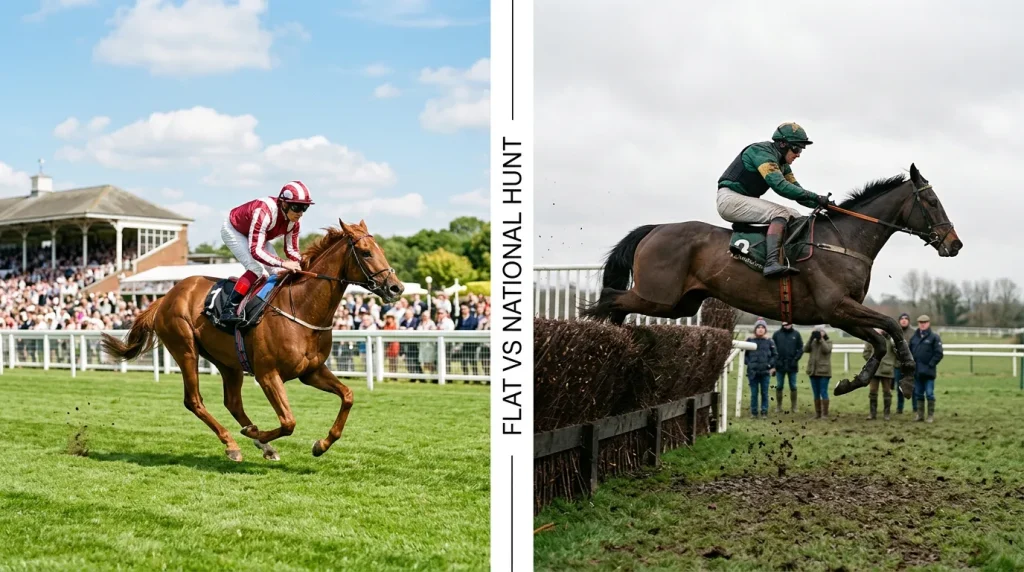
The British racing calendar alternates between these codes. Flat turf dominates summer; National Hunt dominates winter. Some punters specialise exclusively in one discipline; others switch focus seasonally. Either approach can succeed, but both require recognising that success factors differ fundamentally between the codes.
This guide explores those differences—in the racing itself, in form analysis, in market characteristics—and considers whether specialisation serves punters better than attempting to master both.
Flat vs National Hunt Racing — More on this topic at horse racing betting odds.
Fundamental Differences
Distance ranges differ substantially. Flat racing in Britain runs from five furlongs (about 1,000 metres) to two miles and six furlongs for the Cesarewitch. Most flat races fall between six furlongs and a mile and a half. National Hunt races start at two miles for the shortest hurdles and extend beyond four miles for extreme stamina tests like the Grand National.
Career patterns follow different trajectories. Flat horses typically race from age two, peak between three and five, and often retire to stud or breeding before reaching double digits. National Hunt horses rarely race until age four or five over obstacles, peak between seven and ten, and compete into their early teens. Betting on a five-year-old means something entirely different between the codes.
The obstacle factor introduces genuine uncertainty in National Hunt racing. Hurdles and fences present physical challenges that level ground does not. Horses fall; races end prematurely regardless of ability. A flat race favours the fastest horse that day; a National Hunt race favours the fastest horse that jumps adequately. This additional variable increases unpredictability—and affects both win probability and betting approach.
Risk profiles differ accordingly. Flat racing’s non-completion rate is negligible; horses finish unless something goes seriously wrong. National Hunt racing’s fall and unseated rates vary by race type but are always material. The Grand National historically sees significant non-completions; even routine hurdle races produce occasional casualties. Betting strategies must account for this elevated uncertainty.
Horse populations reflect different quality distributions. The number of high-rated jump horses (130+ rating) dropped nearly 25% from 2022 to 2026—from 706 to 533 horses. This quality concentration affects field depth at championship level, though it may increase predictability at the top end while competitive conditions persist in handicaps.
How Form Analysis Differs
Flat racing analysis emphasises speed figures and class assessments. Timing tells you how fast a horse ran; adjusted for conditions and track, timings produce figures that compare performances across different races. Class levels—Group 1 through Listed, then conditions and handicaps—provide a hierarchy that horses move through during careers. Combining speed evidence with class placement produces flat racing’s analytical core.
National Hunt analysis adds variables that flat racing can ignore. Jumping ability becomes paramount—a fast horse that falls achieves nothing. Assessing jumping competence requires watching races rather than reading form; numbers alone don’t capture whether a horse jumps fluently or laboriously. Stamina over distance matters more when races extend to three or four miles; ground conditions affect outcomes more dramatically when horses tire over longer distances.
Ground preferences carry different weight. Flat racing acknowledges ground preferences, but the relatively short distances limit their impact—a speed horse handles firm ground even if they’d prefer something softer. National Hunt’s longer distances amplify ground effects; a confirmed soft-ground stayer might be ineffective on good ground regardless of class. Matching horses to ground becomes more critical as distances extend.
Trainer and jockey significance differs too. National Hunt’s smaller professional population means top trainers and jockeys handle disproportionate shares of winners. When one trainer handles the best horses and employs the best jockeys, trainer-jockey combinations become analytically important. Flat racing’s larger talent pool spreads success more widely, reducing individual significance.
Fitness and freshness play different roles. Flat horses race more frequently with shorter recovery periods; recent form provides reliable guidance. National Hunt horses race less often with longer gaps; assessing fitness after layoffs requires attention to training reports and market signals that flat analysis might downplay.
Odds and Market Characteristics
Flat racing markets tend toward efficiency. Extensive form databases, professional timing analysis, and concentrated media attention create prices that accurately reflect ability. Finding value requires either exceptional analysis or accepting that fair prices represent the market’s considered judgment. Favourites win at approximately their implied probability, suggesting markets price correctly on average.
National Hunt markets reflect additional uncertainty from obstacles and conditions. Fall risk creates outcomes that pure ability doesn’t determine; this randomness should—and does—affect prices. Favourites win slightly less frequently than flat equivalents, and upsets occur more often. This doesn’t mean value is easier to find; it means the market prices genuine uncertainty appropriately.
Place betting offers different dynamics between codes. Flat racing’s smaller fields mean fewer places are paid; each-way value concentrates in specific circumstances. National Hunt’s larger handicap fields—particularly festival races with 20+ runners—pay more places and create each-way opportunities that flat racing rarely matches. The Grand National paying six places represents an extreme version of this phenomenon.
Market liquidity varies seasonally. Flat racing attracts maximum betting volume during the summer; National Hunt peaks at Cheltenham and Aintree. Off-peak racing in either code may offer less liquid markets where value can hide—or where position-taking becomes difficult at meaningful stakes.
Best Odds Guaranteed typically applies to both codes, but its value differs. Flat racing’s more predictable price movements mean BOG captures smaller differentials; National Hunt’s volatile late markets—driven by ground changes and paddock assessment—can produce larger BOG benefits when selections drift significantly.
Should You Specialise?
Specialisation arguments favour depth over breadth. Mastering one code’s nuances—understanding form patterns, recognising value spots, knowing trainer tendencies—requires substantial effort. Attempting both codes halves available attention while more than doubling required knowledge. Some punters find success comes from concentrated expertise rather than diluted generalism.
The counter-argument notes that seasonal concentration creates natural specialisation anyway. Summer flat racing and winter National Hunt don’t overlap significantly; switching focus seasonally doesn’t require simultaneous mastery. Punters who follow the calendar—flat May through October, jumps November through April—can specialise sequentially rather than simultaneously.
Cross-code insights occasionally prove valuable. Flat racing form informs National Hunt assessment when horses switch codes; some trainers operate successfully in both disciplines. Complete ignorance of one code leaves gaps that knowledgeable punters might exploit. Even specialists benefit from general awareness beyond their primary focus.
Practical considerations influence the choice. Available time for analysis, personal interest in specific race types, and calendar availability all matter. Some punters simply prefer flat racing’s speed or National Hunt’s drama; following preference typically sustains the effort that success requires.
Transitioning between seasons demands adjustment. Form knowledge from the previous code’s season becomes irrelevant; new season’s early racing requires rebuilding understanding. Punters who struggle with these transitions might find year-round focus on one code—including summer jumping or all-weather flat racing—more productive than seasonal switching.
For the form analysis framework that applies across both codes, see our comprehensive guide to reading horse racing form. And for the calendar context that determines when each code offers peak opportunities, our UK racing calendar guide maps the year’s rhythm.
See also Handicap Racing Odds.
