
Handicap Racing Odds: Betting on Competitive Fields
 Available in US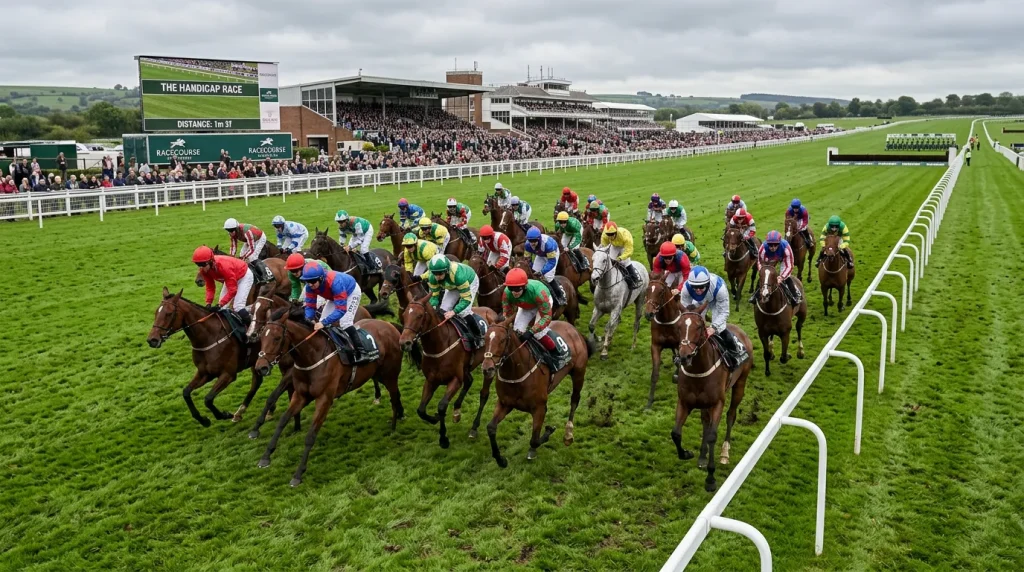
This equalisation creates distinctive betting dynamics. Form analysis must account for weight carried, not just finishing positions. Identifying horses whose ability exceeds their official rating—well-handicapped types—becomes the central analytical task. Large fields spread implied probabilities thinly, creating both opportunity and difficulty.
Understanding the handicap system—how ratings are assigned, how weight affects performance, and where value typically emerges—provides the foundation for profitable handicap betting.
Handicap Racing Odds — More on this topic at horse racing betting odds.
How the Handicap System Works
Every horse in Britain receives an official rating (OR) from the BHA handicapper based on demonstrated ability. A higher rating indicates better form; the scale typically runs from around 45 for the weakest horses to 175+ for elite performers. The rating determines weight allocation in handicaps: a horse rated 100 carries more than one rated 85, with each rating point typically equating to one pound of weight.
The handicapper adjusts ratings after each run. Win a race convincingly and your rating rises—sometimes substantially. Finish well beaten and your rating might drop. Run to your mark and it stays level. The handicapper aims to assess true ability; every run provides evidence that informs that assessment.
Weight-for-age allowances adjust for maturity in races that mix age groups. Three-year-olds receive weight from older horses early in the season, with the allowance decreasing as the year progresses. These allowances reflect average development patterns, but individual horses develop at different rates—creating opportunities when the allowance under- or over-compensates for specific horses.
Penalties apply for recent wins. A horse winning close to a race entry deadline might incur a penalty—additional weight above their official rating—if the handicapper hasn’t yet raised their mark. Penalties increase weight burden while wins indicate ability; assessing whether the penalty fairly reflects improvement matters.
The handicapper’s constraints limit rating accuracy. Ratings can only reflect demonstrated form; a horse showing less than true ability—through circumstance, instruction, or development stage—receives a rating below actual capacity. When that horse subsequently runs to potential, the rating lags reality. Finding horses where the rating underestimates ability is handicap betting’s core objective.
Finding Value in Handicaps
Well-handicapped horses—those whose current ability exceeds their official rating—represent the obvious value target. Several circumstances create this discrepancy.
Improving horses present the clearest opportunity. A horse whose form is progressing with each run might be rated based on early-season performances that no longer reflect current ability. By the time the handicapper raises the rating, the horse wins off the lower mark. Identifying improvement trajectory—physical development, trainer comments, running style changes—helps anticipate ratings that lag reality.
Lightly raced horses offer similar potential. A horse with few runs provides limited evidence for rating assessment. The handicapper estimates ability from a small sample; actual ability might exceed or fall short of that estimate. Horses improving with racing experience, or those whose previous runs were compromised by circumstances, can outperform ratings based on incomplete evidence.
Horses returning from layoffs sometimes slip in the handicapper’s assessment. During absence, other horses have improved; the returning horse’s static rating might represent better relative quality than when it was assigned. If the horse returns fit—always the crucial uncertainty—a potentially lenient rating awaits.
Conversely, poorly handicapped horses deserve opposition. Exposed horses whose ratings fully reflect—or even exceed—their ability struggle in competitive handicaps. Multiple runs at similar ratings without success suggest the mark is appropriate; backing such horses hopes for circumstances to change rather than ability to exceed rating.
Course and distance suitability override pure rating comparison. A horse rated 90 running over its optimal trip at a favoured course might outperform a 95-rated rival unsuited by conditions. Handicap analysis must combine rating assessment with traditional form factors.
Field Size and Market Dynamics
Handicap fields range from small (8-10 runners in conditions handicaps) to enormous (25-40 in festival handicaps). Field size dramatically affects betting approach.
Large fields spread implied probability across many horses. When twenty horses each have genuine winning chances, even the favourite might represent only 15-20% implied probability. The market struggles to separate contenders; prices reflect uncertainty rather than conviction. This creates opportunity—meaningful edge might exist for strong selections—but also genuine difficulty in identifying value among many plausible candidates.
Place betting suits large fields particularly well. When six horses fill the places, finding one among them becomes significantly easier than finding the winner. Each-way betting captures this dynamic: the place portion offers realistic return prospects while the win portion provides upside. Place-only betting—accepting shorter odds for higher probability—suits horses whose chances of finishing prominently exceed their winning chances.
Market volatility increases with field size. A horse gambled on from 25/1 to 10/1 in a small field represents meaningful support; the same move in a 30-runner handicap might reflect proportionally similar money but less total significance. Reading market moves requires calibration to field context.
Smaller handicap fields offer more predictable dynamics. Class distinctions become clearer when fewer horses compete; form analysis identifies fewer candidates. Markets achieve greater efficiency; finding value requires sharper analysis rather than navigating noise.
The trade-off between field sizes presents no clear optimal choice. Large fields offer more potential value but greater difficulty identifying it; small fields offer clearer analysis but potentially less value available. Some punters specialise in one type; others adapt approach to field conditions.
Key Indicators in Handicaps
Rising stars—horses whose ratings are climbing—merit attention if they haven’t yet reached their ceiling. The pattern of improving performance, rising rating, and continued improvement suggests ability exceeding current assessment. When a horse has won twice off rising marks and faces another rating increase, the question is whether improvement continues. Historical patterns from similar horses, trainer tendencies with developing types, and physical scope for further progress inform judgment.
Exposed plodders—horses with extensive records showing consistent but limited ability—rarely offer value at realistic prices. Their ratings accurately reflect demonstrated ability; betting hopes for them to suddenly exceed that established level. Unless circumstances strongly favour them, the market’s modest assessment is probably correct.
Weight trend matters beyond absolute burden. A horse dropping from 10st 7lb to 9st 7lb has a significantly reduced task; the handicapper has lowered their assessment, and the weight reduction reflects that. Whether the dropped rating represents declining ability or temporarily suppressed form determines whether the lighter weight creates opportunity or reflects reality.
Trainer and jockey combinations carry information. When a trainer books their first-choice jockey for a handicap runner instead of an apprentice, intent may differ from lesser-rider bookings. Trainer patterns—whether yards target specific race types, how they place improving horses—provide context that raw form misses.
Draw matters in specific circumstances. Flat handicaps on straight courses and tight all-weather tracks show draw biases that handicapper ratings cannot address. A well-handicapped horse drawn badly faces obstacles beyond weight; a fairly-handicapped horse drawn ideally gains advantages not reflected in ratings. Draw analysis adds a dimension that form-only approaches miss.
For the each-way strategies that suit large-field handicaps particularly well, see our comprehensive each-way betting guide. And for the biggest handicap of all—where these principles apply at maximum scale—our Grand National betting guide addresses the specific challenges of the world’s most famous handicap chase.
See also Maiden Race Betting.
