
Betfair Starting Price (BSP): How Exchange SP Works
 Available in US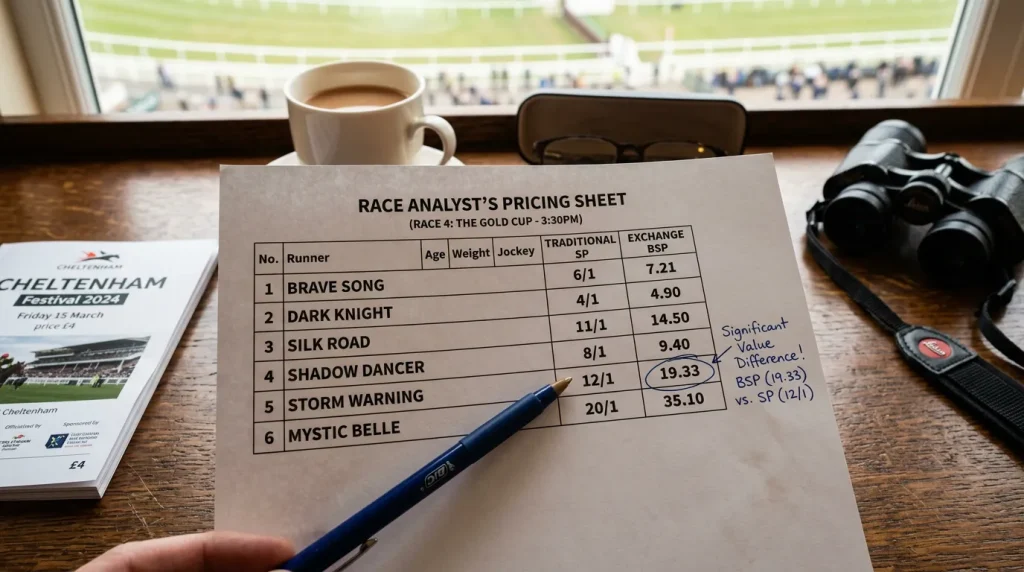
BSP appeals to punters who want exchange pricing without actively trading before races. You place a bet requesting BSP; the exchange calculates your odds based on market activity at the off; your bet is matched at that calculated price. The process is passive—you’re accepting whatever price the market produces rather than specifying odds yourself.
This guide explains how BSP is calculated, compares it to traditional SP, identifies when BSP offers strategic advantages, and addresses the commission impact that affects BSP value.
Betfair Starting Price (BSP) — More on this topic at horse racing betting odds.
How BSP Is Calculated
BSP calculation occurs at the moment a race begins. The exchange examines all unmatched orders—bets waiting to be matched at specified prices—and calculates a single price that would clear the maximum volume from both backers and layers.
The mechanism is more sophisticated than simply averaging available prices. BSP represents the price point where back demand and lay supply intersect most efficiently. If large back orders exist at 4.0 and large lay orders at 4.2, BSP might settle at 4.1—the price that matches maximum volume from both sides.
Unmatched orders drive the calculation. Punters who place limit orders before races—specifying the minimum odds they’ll accept for backs or maximum odds they’ll accept for lays—contribute to the order book that determines BSP. The more liquid the market, the more orders available, and the more reliable the resulting BSP.
BSP bets themselves contribute to the calculation. When you request BSP, your stake joins the pool of unmatched orders. Large BSP orders can influence the final price, particularly in less liquid markets. On major races with substantial trading activity, individual BSP orders have minimal impact; on minor races with thin markets, a significant BSP order might move the calculated price.
The exchange publishes projected BSP figures before races, updating as trading develops. These projections help punters assess whether BSP might offer value compared to available fixed prices. However, projections can shift substantially in the final minutes before a race as late orders enter the market.
Once calculated, BSP is final. Your bet matches at the determined price; there’s no negotiation or adjustment. If BSP settles at 5.0 and you expected 6.0, you’ve taken a shorter price than anticipated. This uncertainty represents BSP’s primary disadvantage compared to requesting specific odds.
BSP vs Traditional SP
Traditional SP derives from on-course bookmaker prices at racecourses. Independent officials record odds from designated bookmakers’ boards at the moment the race starts; SP represents a calculated average of those recorded prices. This system has operated for decades and carries regulatory weight—disputes about payouts often reference SP as the official price.
BSP typically offers better value than traditional SP. The exchange operates without the built-in margins that on-course bookmakers include. Research comparing BSP to SP across seasons has found meaningful differences: one analysis showed backing at BSP produced a gain of +191 points compared to +69 points at traditional SP over identical selections. The margin difference compounds across hundreds of bets.
The gap isn’t uniform across all price ranges. BSP advantage tends to be largest on medium-priced horses where both markets have substantial liquidity. On very short-priced favourites, the difference narrows—both markets price near-certainties similarly. On extreme outsiders with thin exchange liquidity, BSP can be erratic while traditional SP may be more reliable.
Liquidity determines BSP reliability. Major UK and Irish races produce substantial exchange trading; BSP reflects genuine market assessment. Minor races, foreign meetings, and low-profile cards generate less exchange activity; BSP in these markets may be less efficient, occasionally settling at prices that seem detached from reasonable value.
Traditional SP has one significant advantage: Best Odds Guaranteed applies to it but not to BSP. If you back a horse with a BOG bookmaker at morning price and SP exceeds that price, you’re paid at SP. BSP bets don’t qualify for BOG. This creates scenarios where taking a fixed price with BOG protection outperforms taking BSP, particularly when horses might drift.
Using BSP Strategically
System betting suits BSP particularly well. If you’re backing selections according to predefined criteria—trainer patterns, specific conditions, statistical angles—requesting BSP removes the need to monitor markets for each race. You place your bets, specify BSP, and accept the prices that emerge. The approach scales efficiently across multiple selections.
BSP suits punters who can’t follow markets closely. Work commitments, time zone differences, or simply preferring not to watch every race make pre-race price monitoring impractical. BSP lets you place bets hours or days in advance, knowing you’ll receive market-determined odds without further involvement.
Taking BSP makes sense when you expect prices to shorten. If your analysis suggests a horse will attract support and its price will contract, requesting BSP means you’ll receive whatever the market settles at—potentially longer than the price you’d have had to take earlier if you wanted a specific matched bet.
Conversely, avoid BSP when you expect drift. If a horse’s morning price looks generous and you anticipate lengthening, take the fixed price now. BSP will reflect the drifted price; you’ve forfeited value by waiting. The decision parallels the SP-versus-early-price choice with traditional bookmakers.
Combining BSP with minimum odds requests provides some protection. Betfair allows you to specify minimum BSP odds—your bet only matches if BSP meets your threshold. This prevents being matched at surprisingly short prices, though it also means your bet won’t match at all if BSP falls below your minimum.
Arbitrage between BSP and bookmaker SP occasionally offers opportunities. When you anticipate traditional SP will exceed BSP—perhaps due to on-course conditions or betting patterns—you might lay at BSP and back at SP, profiting from the differential. These situations require specific market reading skills and arise infrequently.
Commission Considerations
Exchange commission applies to BSP winnings just as it applies to other matched bets. Betfair’s standard commission rate is 5%, though this can reduce to 2% through volume-based discount programmes. Commission erodes the theoretical BSP advantage over traditional SP.
The calculation matters for marginal cases. If BSP is 5.0 and traditional SP is 4.8, BSP looks superior. But after 5% commission, BSP effectively pays 4.8—identical to traditional SP. The BSP advantage only materialises when the price differential exceeds commission impact.
Lower commission rates widen BSP’s advantage. Punters who’ve achieved discounted commission through sustained trading volume benefit more from BSP selection. A 2% commission rate means BSP needs to exceed traditional SP by much less to deliver superior value.
Commission doesn’t apply when BSP bets lose—only winning bets incur the charge. This asymmetry affects expected value calculations but doesn’t change the fundamental point: commission reduces BSP returns, and the reduction must be factored into BSP-versus-SP decisions.
For the broader exchange betting context that makes BSP possible, see our comprehensive betting exchange guide. And for the traditional SP comparison that helps determine when BSP suits specific situations, our guide to Starting Price versus early odds covers the decision framework.
See also Laying Horses on Betting Exchanges.
