
Draw Bias in Horse Racing: Course-by-Course Analysis
 Available in US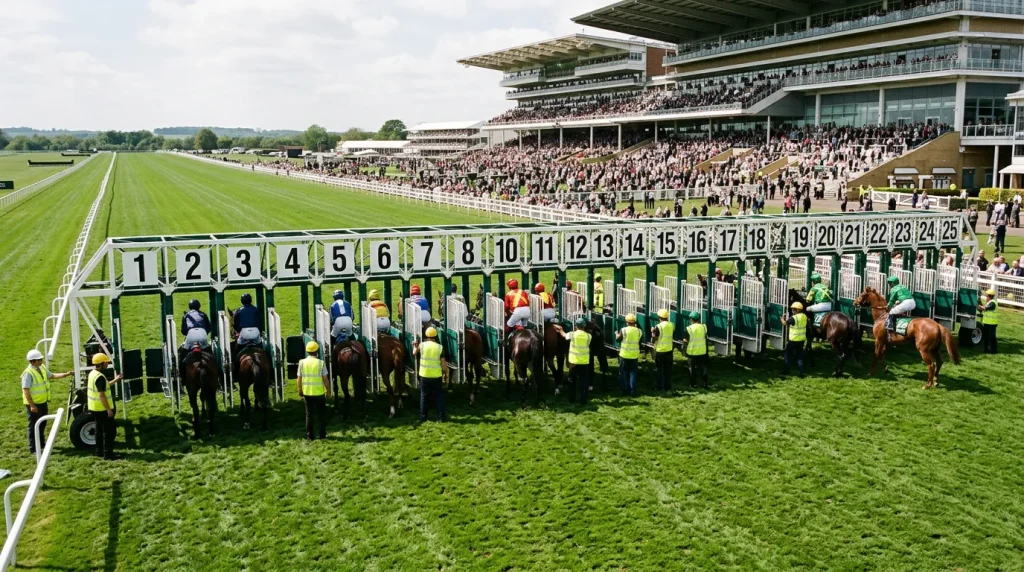
The bias exists because racecourses aren’t uniform. Ground conditions vary across the track width; camber favours horses on particular paths; turns come quickly at some distances, rewarding inside draws. These physical realities translate into measurable advantages that statistical analysis confirms and systematic bettors exploit.
This guide explains why draw bias exists, identifies specific UK courses where it matters most, and shows how to incorporate draw data into betting decisions without letting it override other form factors.
Draw Bias in Horse Racing — More on this topic at horse racing betting odds.
Understanding Draw Bias
Draw bias emerges from track geometry and surface variation. Several factors contribute, often interacting to create course-specific patterns.
Track camber affects drainage and running surface. Flat tracks present less bias; cambered tracks encourage water to drain toward lower sections, creating faster ground on one side. Horses drawn on the faster strip run on better surface throughout; those on the slower section fight inferior conditions the entire race. Over five or six furlongs, this difference accumulates into measurable position loss.
Ground variation follows from drainage patterns and maintenance routines. Fresh ground near the rail might be faster than chewed-up ground toward the centre, or vice versa depending on recent use. When ground staff position the running rail, they’re implicitly creating preferred racing lines. Horses drawn to access those lines gain; others must navigate to reach them or accept slower paths.
Turn configuration creates geometry-based bias. On straight courses, track positioning matters less tactically—horses can spread across the width. On courses with early turns, inside-drawn horses save ground while outside draws travel farther. The distance advantage accumulates: an extra length per furlong around a bend translates to genuine disadvantage over the race.
Pace scenarios interact with draw. When speed horses cluster on one side, they compete for the lead among themselves while the other side races more moderately. Closers drawn among the speed horses get dragged into faster pace than those drawn among hold-up horses. These interactions are harder to predict than physical track factors but affect outcomes in certain field compositions.
Field size amplifies draw effects. In small fields, horses can navigate to preferred positions without interference. In large fields, paths close and repositioning becomes costly. Sprint handicaps with 15+ runners create conditions where draw disadvantage becomes nearly insurmountable.
Key Courses with Draw Biases
Chester presents Britain’s most extreme draw bias. The tight, left-handed circuit means inside draws hold massive advantages at sprint distances. A horse drawn in stall 1 can hug the rail; one drawn in stall 12 travels significantly farther on every bend. Analysis shows low draws win far more frequently than random distribution would suggest. Backing well-drawn horses at Chester—or opposing those drawn poorly—provides genuine edge.
Beverley creates bias through its undulating, turning track and straight-course characteristics. The right-handed circuit favours different draws depending on distance and ground conditions. On the straight course, stands’ side often holds an advantage, though this varies with going. Regular monitoring of Beverley results reveals current patterns more reliably than historical averages.
Epsom challenges horses with unique camber and downhill sections. Draw interacts with ability to handle the track’s peculiarities; some horses navigate regardless of stall, while others are compromised by unfavourable draws. The Derby field historically sees draw patterns, though class overcomes position for genuine contenders.
Ayr shows bias particularly in large-field sprints. The straight six furlongs and five furlongs can favour either high or low draws depending on ground conditions and where the running rail sits. Checking recent results at Ayr sprint distances reveals whether high or low draws currently hold advantage.
Goodwood presents course-specific challenges that affect draw. The track’s unique topography—climbing, turning, undulating—creates positional advantages. Summer meetings often see patterns emerge; the Stewards’ Cup, run over six furlongs with maximum fields, historically shows draw significance that serious Goodwood punters monitor.
Hamilton and Musselburgh show draw effects that Scottish racing regulars know to respect. Tight turns reward inside positions; straight-course races see ground variation create bias. These smaller tracks attract less attention than southern counterparts, potentially leaving edge for punters who study their draw patterns.
All-weather tracks exhibit draw patterns too. Wolverhampton’s tight turns favour low draws at certain distances. Lingfield’s all-weather course shows patterns that differ from its turf configuration. Polytrack and Tapeta surfaces create different grip characteristics that interact with draw positioning.
Using Draw Data in Betting
Draw data identifies horses whose form assessment needs adjustment based on stall position. A horse with solid form drawn poorly at a biased course deserves lower backing confidence; one with modest form drawn advantageously might offer value at longer prices.
Finding overlooked horses requires comparing draw advantage to market odds. When a horse drawn ideally at a biased course drifts in the market—perhaps because its recent form was compromised by poor draws elsewhere—the combination of improved draw and value price creates opportunity. Conversely, horses backed on form but drawn poorly may be overbet relative to their actual winning chances.
Draw can override form in extreme cases. At Chester sprints, a poorly-drawn horse needs to be significantly superior to overcome positional disadvantage. If two horses are closely matched on form but one holds a major draw advantage, the well-drawn horse probably wins more often. Recognising when draw becomes determinative rather than merely influential sharpens betting decisions.
Statistical analysis supports draw-based adjustments. Tracking win rates by stall position at specific course-distance combinations reveals genuine biases versus random noise. Commercially available data services provide this analysis; self-tracking confirms whether published patterns hold in current conditions.
Combining draw with other factors produces the best results. Draw advantage alone doesn’t make a bad horse good, but it makes competitive horses more likely to win. Horses suited by conditions, in form, and well-drawn represent the strongest bets—those where multiple factors align.
When Bias Changes
Draw bias isn’t static. Ground conditions shift patterns: the stands’ side advantage on a straight course might reverse when ground conditions change. What held last month may not hold today. Adaptive tracking of current patterns outperforms reliance on historical averages.
Rail position alterations change effective draw value. When the running rail moves to protect ground, the optimal racing line shifts. A high draw that hugged the far rail last week might be far from the new rail position this week. Course announcements about rail movements deserve attention.
Field size moderates bias effects. In small fields, horses can navigate freely; draw matters less. In maximum-field sprints, positional disadvantage locks in. Assessing draw importance relative to field size calibrates how much weight to give positional factors.
Seasonal patterns reflect track maintenance cycles. Fresh ground early in a meeting might favour certain positions; ground that deteriorates through the card shifts advantages. Racing late on a card differs from early races at the same venue on the same day.
For understanding how ground conditions interact with draw, see our comprehensive going guide. And for the broader form analysis framework that integrates draw alongside other factors, our main form guide provides the complete picture.
See also Jockey Booking Analysis.
