
Horse Racing Pace Analysis: Front-Runners vs Closers
 Available in US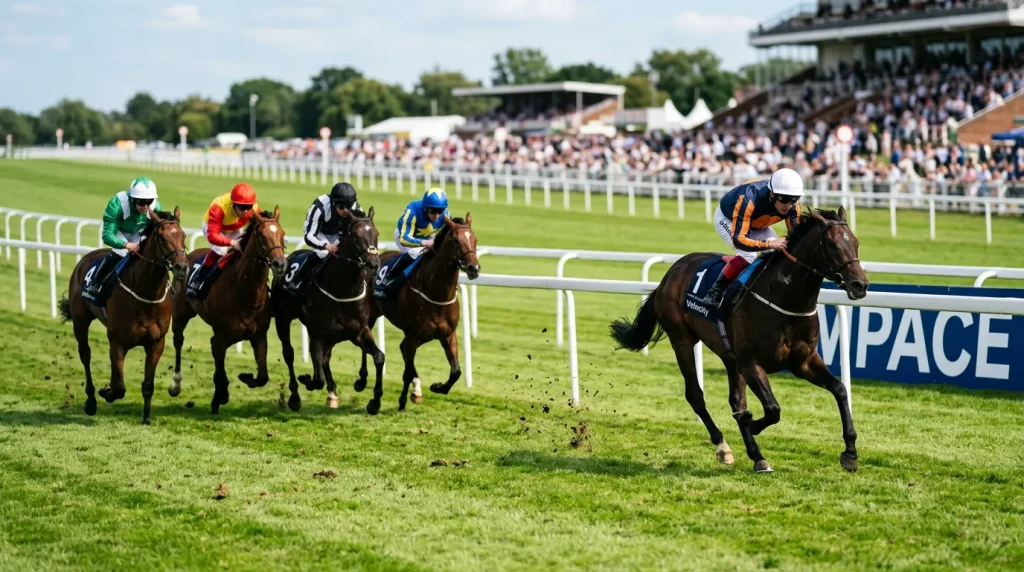
Pace matters because race dynamics affect outcomes. When multiple front-runners contest the lead, they expend energy fighting each other while closers conserve effort for the finish. When a single front-runner faces no early pressure, they can dictate tempo and arrive at the final furlong with reserves that hold-up horses can’t overcome. Recognising these scenarios before the race—rather than explaining them afterward—provides edge.
This guide explains running styles, how different pace scenarios affect results, how track configuration influences pace advantages, and how to incorporate pace assessment into practical betting decisions.
Horse Racing Pace Analysis — More on this topic at horse racing betting odds.
Understanding Running Styles
Front-runners lead from the start. They break quickly from the stalls, establish position at the head of affairs, and try to maintain that lead throughout. Some front-runners are genuine pace-setters who need to dominate; others can sit second or third but prefer to race prominently. Form comments like “made all,” “led,” or “raced prominently” identify front-running tendencies.
Stalkers race just behind the leaders. They track the pace without setting it, preserving energy while maintaining close contact. When the pace quickens, they’re positioned to respond; when it slows, they’re close enough to pounce. Stalking represents the tactical middle ground—neither dictating terms nor surrendering them entirely.
Hold-up horses race toward the rear. They settle behind the field, conserve energy through the early stages, and produce their effort in the closing stages. Comments like “held up,” “came from behind,” or “stayed on” indicate hold-up style. These horses need time to build momentum; they can’t accelerate instantly from a standing start.
Identifying style requires form study. Watch race replays or read positional comments that describe where horses raced at various stages. Consistent patterns emerge: horses that habitually lead, others that habitually settle. Some horses show tactical versatility—they’ve won from different positions—but most have preferred methods.
Trainer methods influence style. Some trainers instruct jockeys to ride positively from the front; their runners consistently adopt forward tactics. Others prepare horses to finish strongly from off the pace. Knowing trainer preferences helps predict tactics even before race instructions are given.
Jockey tendencies add another layer. Certain jockeys prefer front-running tactics; others specialise in hold-up rides. When an aggressive rider takes a hold-up horse, tactical conflict may arise. When a patient jockey rides a front-runner, they might restrain it differently than a more forward partner would.
Pace Scenarios and Outcomes
Fast pace develops when multiple front-runners contest the lead. Each runner pushes the other; neither can settle into comfortable rhythm. The fractions quicken beyond sustainable levels; leaders tire entering the final stages. Hold-up horses inherit the race as exhausted leaders fade. Fast pace systematically favours closers who’ve conserved energy for the finish.
Slow pace emerges when front-runners face no pressure. A single pace-setter can dictate soft fractions, building reserves for a finishing kick that hold-up horses can’t match. Slow early tempo means closers have ground to make up without the benefit of tired leaders to pass. Lone front-runners in slow-pace scenarios win at elevated rates because nothing tests them until it’s too late.
Contested lead versus uncontested lead represents the crucial distinction. Examining the declared field for front-running types predicts whether pace will be contested. Two or more confirmed front-runners guarantee early pressure; a single pace-maker might face an uncontested lead unless rivals choose to attack.
Field composition determines scenario probability. Count the front-runners in the field; estimate whether they’ll engage or defer. Assess whether stalking types might challenge for the lead or sit behind. Consider whether any hold-up horses might adopt different tactics. This analysis produces a pace scenario prediction that informs selection.
Distance affects pace dynamics. Sprint races compress the impact window; there’s less time for pace scenarios to fully develop. Staying races amplify pace effects; early fractions set up the finish over many furlongs. A sustained fast pace over two miles punishes leaders far more than the same pace over six furlongs.
Ground conditions interact with pace. Soft ground increases energy expenditure at any tempo; fast early pace on soft ground depletes reserves more severely. Firm ground allows efficient travel; leaders can sustain faster fractions without equivalent exhaustion. Adjusting pace expectations for ground conditions improves scenario accuracy.
Track Configuration Impact
Course layouts favour different styles systematically. Understanding track-specific pace advantages helps identify when certain runners gain non-form advantages.
Stiff finishes—tracks with uphill climbs to the line—reward horses with stamina reserves. Front-runners maintaining pace up demanding finishes need exceptional reserves; many weaken. Hold-up horses timing runs to pass struggling leaders benefit from the gradient. Cheltenham and Sandown exemplify stiff-finishing tracks where closers regularly prevail.
Sharp tracks—flat or downhill finishes with minimal gradient—favour front-runners. Without the stiff test that tires leaders, pace-setters can maintain tempo to the line. Closers need extra ground to wind up; if the finish arrives before they’re fully rolling, they can’t catch the leader. Kempton’s flat mile and Wolverhampton’s tight circuit suit forward types.
Turning tracks reward tactical positioning. Tight turns create traffic problems for horses stuck behind walls of rivals. Front-runners and stalkers avoid this trouble; hold-up horses risk being blocked. Chester’s extreme tightness amplifies this effect; wider tracks present fewer navigation issues.
Straight courses eliminate turning concerns but introduce different dynamics. Without bends to string out the field, horses bunch more readily. Closers can switch between gaps; front-runners can’t use corners to maintain separation. Pace scenarios on straight courses develop differently than on turning tracks.
Historical pace data by track confirms theoretical expectations. Some tracks consistently produce front-runner success; others systematically favour closers. Tracking running-style success rates at specific venues reveals patterns that inform selection.
Pace in Betting Decisions
Identifying pace advantages means finding horses whose style suits the predicted scenario. A lone front-runner in a field of closers represents genuine opportunity; no one will pressure the pace, and the leader can control the race. Backing that front-runner acknowledges the tactical setup while most punters focus purely on form.
Closers in bunched fields face structural challenges. When multiple hold-up horses target late runs, they compete for limited positions as the race unfolds. Not everyone can come widest with a clear run; some get blocked. Form that shows finishing ability might not materialise when traffic intervenes. Discounting closers in crowded scenarios acknowledges realistic race dynamics.
Front-runner value emerges when the market underestimates tactical advantages. A front-runner at 10/1 in a field with no other pace might offer genuine value; the price reflects form concerns while the tactical setup favours the style. Recognising when tactical factors outweigh pure form assessment creates edge.
Pace collapses—when expected pace doesn’t develop—represent risk. A front-runner predicted to face pressure might find rivals choosing to settle instead. The lone-front-runner scenario that seemed unlikely materialises; hold-up horses were expecting faster tempo that never arrived. Pace prediction involves uncertainty; strong convictions sometimes prove wrong.
Combining pace with other factors produces the most reliable assessment. Pace analysis alone doesn’t make bad horses good; but it can make competitive horses more or less likely to win depending on scenario fit. A horse suited by ground, in form, well-drawn, and pace-advantaged represents maximum factor alignment.
For draw analysis that interacts with pace on certain courses, see our comprehensive draw bias guide. And for the broader form framework that integrates pace alongside other factors, our main form analysis guide provides complete methodology.
See also Favourite-Longshot Bias.
