
Horse Racing Market Movers: How to Spot and Interpret Steam Moves
Best Horse Racing Betting Sites – Bet on Horse Racing in 2026
Loading...
Horse racing market movers attract attention because they promise information. When a horse’s odds contract sharply—a steam move—the assumption is that someone knows something. Money has arrived, confidence is flowing, and the market is reacting. Following the smart money—or avoiding the trap—depends on reading these signals correctly.
But market movements are information that requires interpretation. Not every shortener wins. Not every drifter loses. The punter who blindly backs every steam move gets poor value on horses that would have shortened anyway, while the punter who fades every move misses genuine gambles. Learning to distinguish meaningful signals from noise separates profitable use of market data from expensive pattern-chasing.
This guide covers how to track price movements, what drives steam moves and drifters, and—crucially—how to incorporate market signals into your betting decisions without letting them override your own analysis.
Reading Market Movements
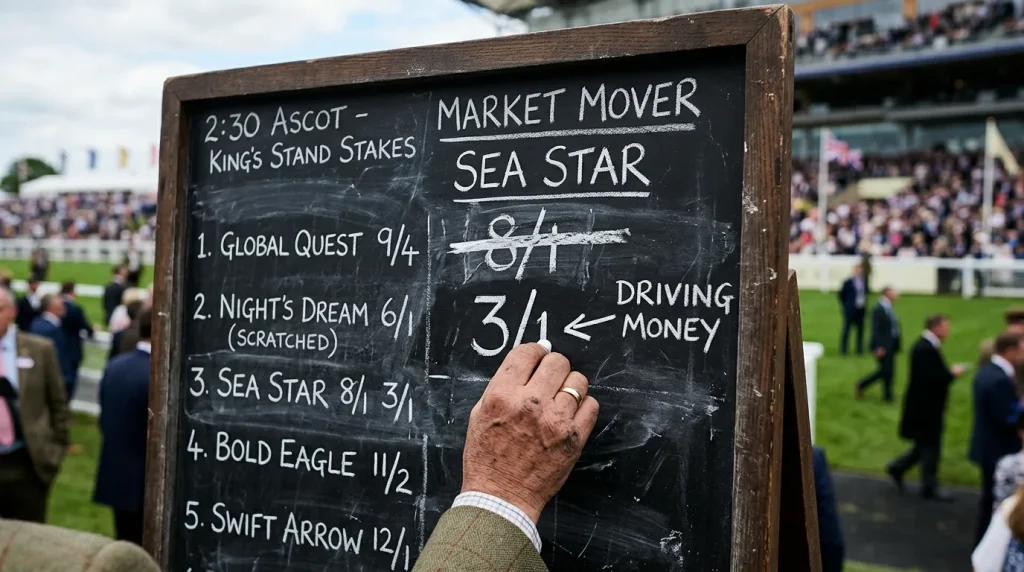
Market movements manifest as odds changes across bookmakers and betting exchanges. A horse priced at 8/1 in the morning might stand at 5/1 by post time—a significant shortening. Another might drift from 6/1 to 10/1 as support fails to materialise. Tracking these changes tells you what the collective money thinks, even if you don’t know who’s betting.
Betting exchanges provide the most granular market data. Research analysing Betfair exchange data captured over one million price signals across 73 markets, with price updates arriving every 50 milliseconds in active trading periods. This sensitivity means exchange prices react almost instantaneously to significant money, making them the sharpest indicator of market sentiment.
Bookmaker odds adjust more slowly. Traders monitor exchange movements and competing bookmakers, adjusting prices to manage liability and maintain competitive positioning. A horse shortening on Betfair will typically see bookmaker prices contract shortly after—though the sequence occasionally reverses when large off-exchange money arrives first.
Several resources track market movements systematically. Racing data services display morning prices alongside current odds, highlighting significant movers. Some betting sites feature dedicated market-mover sections flagging horses showing notable support. Exchange platforms display depth of market—how much money is available at each price point—providing insight into where resistance might halt a move.
Determining what constitutes “significant” movement requires context. A horse moving from 8/1 to 6/1 has shortened materially—roughly 25% in implied probability terms. But a move from 25/1 to 20/1, though nominally substantial, might simply reflect bookmaker price adjustments rather than genuine support. The percentage shift in implied probability matters more than the absolute odds change.
Understanding Steam Moves
A steam move occurs when a horse’s odds contract rapidly, typically in the hour before a race. The pattern is unmistakable: 10/1 becomes 8/1, then 13/2, then 5/1, as money pours on across multiple bookmakers simultaneously. The market is sending a clear signal that significant money backs this horse.
Several factors can trigger steam moves. Stable confidence represents the classic driver—connections know their horse is well-prepared and have backed accordingly. This money often arrives through professional networks, with punters close to yards getting the information first. By the time the market reacts visibly, the informed money is already on.
Jockey switches trigger market moves when a leading rider picks up a spare mount. The booking signals intent and ability, prompting both informed and reactive betting. Similarly, positive paddock reports—a horse looking exceptionally well, moving freely, showing the signs of imminent peak performance—can spark late support from on-course observers.
Conditions changes drive legitimate steam moves. If ground conditions shift to suit a particular horse—unexpected overnight rain producing soft going, or a drying track favouring a speedster—informed punters react before the broader market catches on. These situational moves represent genuine edge for those paying attention.
Tipster recommendations cause artificial steam moves that confuse the picture. When a high-profile newspaper tipster or paid service selects a horse, followers pile on. The price contracts, but the move reflects publicity rather than information. These horses often represent poor value by post time; the early price captured the genuine assessment before hype inflated it.
Not all steam moves succeed. The market is wrong frequently enough that backing every shortener loses money—you’re paying inflated prices for horses whose true probability hasn’t changed, only their betting popularity. The challenge is distinguishing informed moves from false signals.
When Horses Drift
Drifters are horses whose odds lengthen as race time approaches. The morning price of 5/1 becomes 7/1, then 8/1, then 10/1 as support fails to materialise or active opposition emerges. The market is saying this horse is less fancied than earlier prices suggested.
Absence of expected support causes natural drift. A horse from a powerful stable might be expected to attract backing; when it doesn’t, the price expands to fill the vacuum. Sometimes this reflects nothing more than different betting patterns—the stable’s usual punters absent, or the horse failing to attract public attention. Other times, it signals genuine negative information: the stable isn’t betting because they’re not confident.
Negative reports drive drift more actively. Poor paddock appearance, lameness concerns, adverse ground changes, or on-course whispers about training issues all reduce demand. Professional punters who access this information stop backing, or even lay the horse on exchanges. The price drifts accordingly.
Early over-betting produces afternoon drift. A horse tipped widely in morning media attracts support before serious money arrives. When the serious money goes elsewhere, the tipster’s selection drifts. The morning price was artificially compressed; the SP reflects truer market assessment.
Drift doesn’t mean a horse can’t win. Some drifters prevail at generous prices—the market was wrong to lose confidence. But the market is right more often than wrong. Statistical analysis consistently shows that shorteners outperform their morning prices while drifters underperform. Following the money isn’t foolproof, but opposing it systematically loses.
The question isn’t whether to note drift, but how to incorporate it. If your analysis strongly supports a horse and it drifts, you’re getting enhanced value—assuming your analysis is sound. If you’re uncertain and the horse drifts, the market is providing information you should probably heed.
Using Market Information
The worst approach to market moves is blind following. Backing every steam move means paying top prices after value has evaporated. By the time a move is visible, you’re buying at inflated levels—the smart money got on earlier, and you’re simply adding to the crowd. Systematic steam-move following produces mediocre returns at best.
The opposite extreme—systematically fading moves—fares worse. Opposing every shortener means backing horses the market has rejected. Sometimes the market is wrong, but not often enough to make contrarian steam-fading profitable.
The pragmatic approach treats market moves as one input among several. Your form analysis produces a selection; market movements either confirm or challenge that view. When your analysis aligns with market support—you like a horse and it’s steaming—conviction increases. When they diverge—you like a horse but it’s drifting—you face a decision: trust your work or defer to the market.
Context shapes interpretation. Early-morning moves before significant betting volume may reflect thin-market noise rather than information. Moves in the final minutes before a race, when on-course money enters the market, carry more weight. Steam moves on televised racing attract copycat betting, diluting signal quality; moves on low-profile cards may be more informative.
Your track record matters. If your selections consistently steam after you identify them, you’re finding horses the market subsequently values—a positive signal about your analysis. If your selections regularly drift, either your analysis is weak or you’re identifying contrarian value that the market disagrees with. Honest assessment of this pattern informs how much weight to give market confirmation.
Some punters use market moves as timing signals rather than selection signals. If you’ve identified a horse you want to back, monitoring the market tells you when to strike. Take the price before it shortens; or wait for a drift before jumping in at enhanced odds. This approach uses market information tactically without letting it override selection decisions.
Market moves are data, not directives. Understanding what drives them—and when to incorporate them versus when to trust your own analysis—transforms reactive betting into strategic decision-making.
For the form analysis skills that generate independent views worth testing against market movements, see our guide to reading horse racing form. And for guidance on whether to lock in prices early or let the market settle, our guide to Starting Price versus early odds addresses the timing question directly.