
Laying Horses on Betting Exchanges: Complete Beginner Guide
 Available in US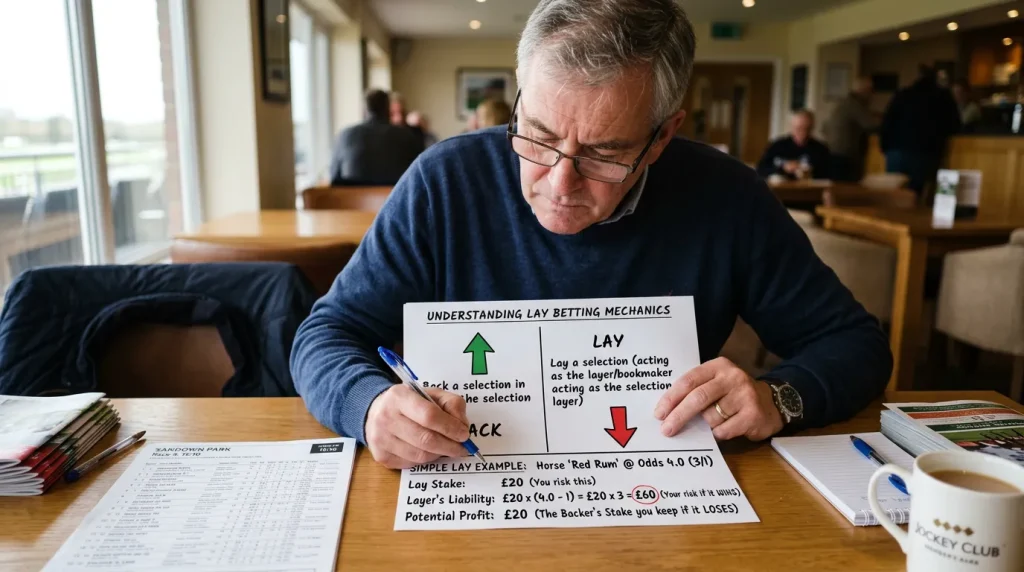
Yet laying is simply the other side of every betting transaction. When you back a horse, someone else lays it. When you lay a horse, you’re taking the bookmaker’s role—accepting someone else’s stake in exchange for keeping that stake if the horse loses. The risk profile differs from backing, but once understood, laying becomes a valuable tool for profiting when horses lose.
This guide explains laying fundamentals, demystifies liability calculations, identifies scenarios where laying makes strategic sense, and provides practical steps for placing your first lay bet.
Laying Horses on Betting Exchanges — More on this topic at horse racing betting odds.
Understanding Laying
When you lay a horse, you’re betting it won’t win. You’re offering odds to backers—acting as the bookmaker. If the horse loses, you keep the backer’s stake as profit. If the horse wins, you pay out at the agreed odds. The risk-reward profile mirrors backing but inverted.
Consider a concrete example. A horse is available to lay at 4.0 (3/1 in fractional terms). You lay £10 at 4.0. This means you’re accepting a £10 back bet from someone else at those odds. If the horse loses, you profit £10—the backer’s stake. If the horse wins, you pay the backer their winnings: £30 (£10 × 3). Your liability—the maximum you can lose—is £30.
The terminology matters. Your “lay stake” is what you stand to win if the horse loses—equivalent to the backer’s stake. Your “liability” is what you pay if the horse wins—the potential payout you’d owe. These figures differ; confusing them leads to stake-sizing errors.
Laying at shorter prices means lower liability but lower profit. If you lay at 2.0, your liability is only equal to your potential profit—a £10 lay profits £10 if the horse loses but costs £10 if it wins. Laying at longer prices means higher liability relative to profit. A £10 lay at 10.0 profits £10 but risks £90.
This liability relationship explains why laying long-priced horses carries significant risk. A 50/1 shot requires £500 liability to profit £10 if it loses. When that 50/1 shot wins, you’ve lost 50 times your potential profit. Laying outsiders demands either tiny stakes or substantial confidence that the horse cannot win.
The exchange facilitates laying by matching you with backers. You post a lay offer at specified odds; backers whose requirements match yours create a matched bet. Both parties’ obligations are secured—the exchange holds funds to cover potential payouts, ensuring bettors receive their winnings regardless of counterparty solvency.
Understanding Liability
Liability represents your maximum loss on a lay bet—the amount you’d pay if the horse wins. Calculating liability correctly prevents unpleasant surprises.
The formula is straightforward: Liability = Lay Stake × (Odds – 1). At odds of 4.0 with a £10 lay stake: £10 × (4.0 – 1) = £10 × 3 = £30 liability. You’re risking £30 to profit £10.
Alternatively: Liability = Backer’s potential profit. If someone backs £10 at 4.0, their potential profit is £30. Your liability equals their potential winnings—because you’re paying those winnings if the horse wins.
The exchange displays liability clearly before you confirm any lay bet. You’ll see both your potential profit (if the horse loses) and your liability (if it wins). This transparency prevents accidental over-exposure, though punters must still consciously process the information rather than clicking through automatically.
Why liability feels scarier than it is: when backing, you risk your stake; when laying, you risk your liability. A £10 stake backing at 4.0 risks £10 to win £30. A lay with £30 liability risks £30 to win £10. The asymmetry feels worse for laying—you’re risking more to win less. But the probability profile balances this: the horse is expected to lose more often than win, which is why backers accept those odds.
Managing liability requires discipline. With Betfair charging 5% commission on winnings, net profits from successful lays are slightly reduced. Factor commission into your liability assessments, particularly when laying at short prices where margins are tight.
Multiple lay bets accumulate liability. If you’ve laid five horses with £30 liability each, your total exposure is £150 if they all win. In practice, not all will win—that’s why you laid them. But understanding aggregate exposure prevents over-commitment across a day’s racing.
When Laying Makes Sense
Opposing false favourites represents laying’s most intuitive application. When a horse is overbet relative to genuine winning chance—perhaps through media hype, punter sentiment, or recent form that doesn’t transfer to today’s conditions—laying captures value from market mispricing. You’re betting the favourite is worse than the market thinks.
Trading positions uses laying to secure profit from backing decisions. You back a horse at 5.0; its price shortens to 3.0 as the race approaches. Laying at 3.0 locks in profit regardless of outcome. If the horse wins, your back wins more than your lay loses. If it loses, your lay wins more than your back loses. The skill lies in reading which way prices will move.
Matched betting combines bookmaker free bets with exchange laying to generate guaranteed profit. You use a bookmaker’s promotional offer to back a horse; simultaneously, you lay the same horse on the exchange. The back and lay offset each other; the free bet profit extracts value from the promotion. Matched betting is systematic rather than speculative, requiring careful stake calculation but minimal racing knowledge.
Laying in-play suits punters who read races well. When a fancied horse is travelling poorly mid-race—struggling to maintain position, failing to respond to jockey urgings—its price often remains shorter than warranted as hope persists. Laying distressed horses captures value from delayed market adjustment.
Specific scenarios favour laying over backing. When you’re confident a horse cannot win but uncertain which rival will, laying that horse is more efficient than backing multiple alternatives. When your analysis produces negatives—reasons a horse will fail—rather than positives, laying expresses that view directly.
Your First Lay Bet
On Betfair, navigate to the horse racing market for your chosen race. Each horse displays two prices: the blue figure is the back price; the pink figure is the lay price. The lay price is always slightly higher than the back price—this spread represents the market’s transaction cost.
Click the pink lay price for your selected horse. A bet slip appears showing the odds you’re laying at. Enter your stake—this is the amount you’ll profit if the horse loses. The slip automatically calculates and displays your liability—what you’ll pay if the horse wins.
Review both figures before confirming. Ensure the liability is acceptable relative to your bankroll. Confirm the bet; the exchange matches it with a backer or queues it until a matching backer appears. Your funds covering the liability are reserved until the bet settles.
After the race, the bet settles automatically. If the horse lost, your account credits with the backer’s stake minus commission. If the horse won, your liability is deducted to pay the backer’s winnings.
Start with small stakes while learning. The liability mechanics take adjustment; mistakes happen. Limiting exposure during the learning period reduces the cost of errors. As comfort develops, scale appropriately.
For the broader exchange context that enables laying, see our comprehensive betting exchange guide. And for BSP strategies that incorporate laying possibilities, our Betfair Starting Price guide covers the exchange’s alternative to traditional SP.
See also Racing Tips and Tipsters.
