Odds-On Favourites Explained: Betting on Short-Priced Horses
Best Horse Racing Betting Sites – Bet on Horse Racing in 2026
Loading...
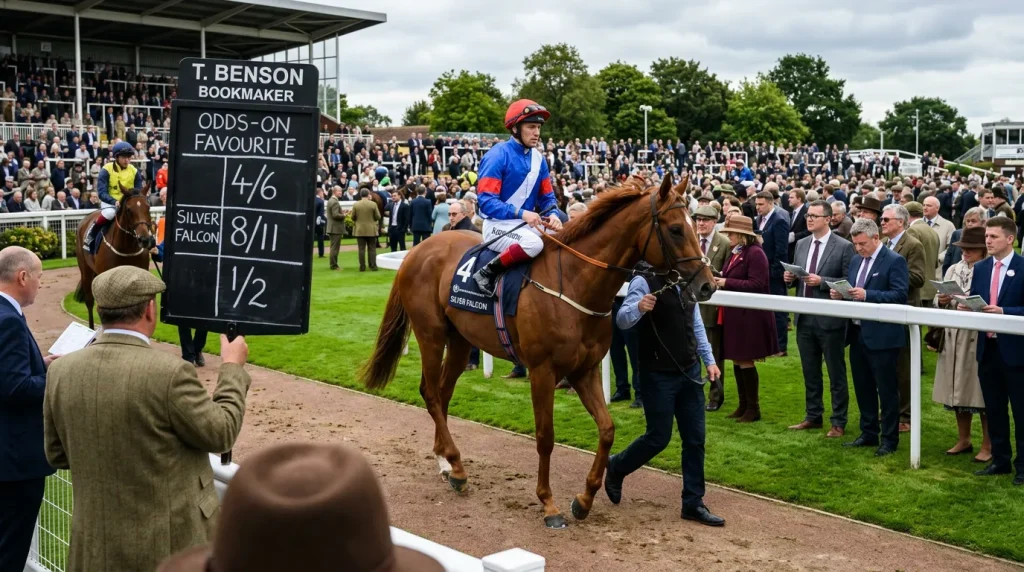
The odds-on favourite meaning becomes clear the first time you see it on a betting board: a price where your potential reward is less than your stake. It feels counterintuitive. Why would anyone risk £10 to win £5? Yet odds-on betting represents a significant portion of wagers in UK horse racing, particularly in small-field races where one contender towers above the rest.
The paradox dissolves when you consider probability. An odds-on price signals that the market believes a horse is more likely to win than to lose—sometimes substantially more likely. A 1/3 shot, in theory, wins three times out of four. That implied certainty attracts punters who prefer frequent small wins to occasional large payouts.
But theory and reality don’t always align. Horses priced at 4/9 get beaten. Heavily backed favourites find the race setup against them, the ground wrong, or a rival they’d underestimated. The market’s assessment is just that—an assessment. Understanding when odds-on prices represent genuine value, and when they’re a trap masquerading as a safe bet, separates shrewd punters from those who bleed money on “certainties” that turn out to be anything but.
This guide examines the mechanics of odds-on betting, identifies scenarios where backing short prices makes strategic sense, and—perhaps more importantly—exposes the risks that aren’t obvious until you’ve experienced them firsthand.
How Odds-On Prices Work
An odds-on price is any fractional odds where the first number is smaller than the second. The name comes from the comparison: the odds are literally “on” the horse, meaning you must stake more than you stand to profit.
At 1/2 (one to two), you stake £2 to win £1 profit. Place a £20 bet and you’ll receive £30 back if successful—your original £20 plus £10 profit. The implied probability here is roughly 67%, meaning the market believes this horse wins two out of every three times in similar conditions.
At 4/6 (four to six, sometimes expressed as 2/3), you win £4 for every £6 staked. A £30 bet returns £50. Implied probability: around 60%.
At 4/9, you win £4 for every £9 wagered. A £45 bet returns £65. The implied probability rises to approximately 69%.
At 1/4, one of the tightest prices you’ll commonly see, you stake £4 to win £1. A £100 bet returns only £125. The market is saying this horse wins four times out of five. These prices appear on horses perceived as near-certainties—top-class performers dropping in grade, or dominant horses facing weak opposition.
At 8/13, you win £8 for every £13 staked. A £26 bet returns £42. This sits in the middle of the odds-on range—enough confidence to make the horse favourite, but not overwhelming dominance. Implied probability: about 62%.
The mathematics of return calculation remains consistent with longer odds. Divide the first number by the second to get your profit per pound, multiply by your stake, then add the stake back for total return. What changes is the psychology. At 5/1, you’re dreaming of a £50 profit from a £10 stake. At 1/2, you’re hoping for £5 profit while risking £10. The emotional experience of winning differs fundamentally, even when the absolute profit might be the same.
Understanding implied probability helps you assess whether an odds-on price represents value. To convert fractional odds to implied probability: divide the denominator (second number) by the sum of both numbers, then multiply by 100. For 1/2: 2 ÷ 3 × 100 = 66.7%. If you genuinely believe the horse has a 75% chance—perhaps based on form study that the market hasn’t fully appreciated—then 1/2 offers value despite being odds-on.
When Backing Odds-On Makes Sense
Not all odds-on bets are created equal. Some represent genuine value; others are traps dressed as sure things. The distinction lies in context.
Weak opposition in small fields. A Listed performer running in a novice stakes at a minor track, facing four moderate rivals, might justifiably be 1/3. The class gulf is real. The same horse at the same price against proven competitors would be a different proposition entirely. Always assess the opposition, not just the selection.
Conditions that suit perfectly. Some horses transform on their preferred ground. A soft-ground specialist encountering heavy going might be odds-on for good reason—the conditions neutralise better horses who can’t handle the mud. Trainer intent matters too: when a powerful yard targets a specific race with a horse suited to every aspect of the conditions, the short price reflects genuine superiority.
Accumulators and multiple bets. Here’s where odds-on backing becomes strategic rather than emotional. A 1/2 shot on its own offers modest returns. But include three 1/2 shots in a treble and the combined odds reach roughly 3.375 in decimal (or about 7/3)—suddenly you’re getting £23.75 from a £10 stake. The accumulator transforms short prices into something more interesting. Of course, all three must win, and that’s where the mathematics gets brutal.
Market confidence aligned with your analysis. When your own form study reaches the same conclusion as the market—that this horse should win—backing at odds-on isn’t blind trust. It’s agreement. The danger comes when you back short prices simply because they’re short, without doing the work to confirm the market’s assessment. Price alone doesn’t make a selection correct.
Academic research into betting markets provides interesting context. Studies examining the favourite-longshot bias—a phenomenon where favourites tend to be underbet relative to their true chances while longshots are overbet—suggest that short-priced horses often offer better value than their lack of glamour implies. Research by Ziemba and Hausch found that at longer odds of 10/1 to 18/1, average returns fall to just 65% of stakes, while at extreme longshots above 18/1, returns collapse to around 28%. Favourites, by contrast, tend to return closer to the theoretical fair rate.
The Hidden Risks of Odds-On Betting
The mathematics of recovery is unforgiving. If you back a horse at 1/2 and lose your £10 stake, you need to win two identical bets just to break even. At 1/3, you need three consecutive wins after one loss to recover. The shorter the price, the longer the chain of success required to climb back from a single failure.
This creates a psychological trap. After a few wins on odds-on shots, punters start to feel invincible. The favourites are landing. The strategy is “working.” Then comes the loss—and suddenly the accumulated profits evaporate. It takes a particular temperament to absorb that loss and continue with discipline. Many punters, chasing recovery, increase stakes or switch to longer odds impulsively. Both responses typically make things worse.
There’s also the opportunity cost to consider. The money tied up in a 1/2 shot could be placed elsewhere at longer odds with potentially better risk-adjusted returns. A £50 bet at 1/2 ties up capital that could fund five £10 bets at 5/1. The latter approach offers more chances for research to prove correct, more opportunities to find genuine value, and more emotional variety across a day’s racing. Concentration in short prices reduces your exposure to the sport’s inherent unpredictability—and that unpredictability is where value often hides.
The “can’t lose” mentality deserves particular scrutiny. Horses get beaten at 1/10. It happens. Races unfold in ways that even the best form students cannot anticipate. Traffic problems, ground changing during the meeting, a rival putting in a career-best performance—any of these can undo a “certainty.” When punters convince themselves that a bet is guaranteed, they often stake more than they should. The loss, when it comes, inflicts damage disproportionate to the expected return.
Consider the mathematics plainly. At 1/4, you must win four out of five just to show any profit. One loss in five wipes out all gains from the other four. That demands an 80% strike rate—a level that even the most dominant horses in training rarely sustain across a full season. The market might price a horse at 1/4, but that doesn’t mean it will win 80% of similar races. It means the market currently believes it will. Markets are often right. They’re not always right.
Research suggests the favourite-longshot bias has weakened since the rise of betting exchanges, as the work of Smith and Vaughan Williams indicates. Sharper pricing means fewer obvious overlays at any price point. If you’re backing odds-on simply because “favourites win more often,” you might be relying on a market inefficiency that no longer exists to the same degree.
Odds-on betting isn’t inherently good or bad strategy—it depends entirely on whether the price reflects genuine value. That assessment requires the same discipline you’d apply to any selection: form analysis, understanding of conditions, and honest evaluation of where the market might be wrong.
For the analytical framework to assess whether any price—short or long—offers value, our guide to value betting in horse racing provides the probability calculations and practical methodology to make these judgments consistently.