
Royal Ascot Odds Guide: Betting the Flat Racing Showpiece
Best Horse Racing Betting Sites – Bet on Horse Racing in 2026
Loading...
Royal Ascot odds represent the pinnacle of British flat racing betting. Five days in mid-June, 35 races, the finest flat horses from Britain, Ireland, France, America, Australia, and beyond—where elite flat racing meets elite betting opportunities. No other meeting combines such consistent quality across such diverse race types.
The meeting draws enormous crowds and substantial betting volume. British racecourse attendance exceeded 5 million in 2026 for the first time since 2019, with Royal Ascot contributing significantly to that figure as the flagship summer event. The betting markets reflect this prestige, attracting sharp money that creates efficient prices and rewards thorough preparation.
This guide covers the meeting’s structure, approaches to different race types, and the specific factors that influence outcomes at Ascot—helping you navigate the most important week in the flat racing calendar.
Royal Ascot: Five Days of Elite Racing
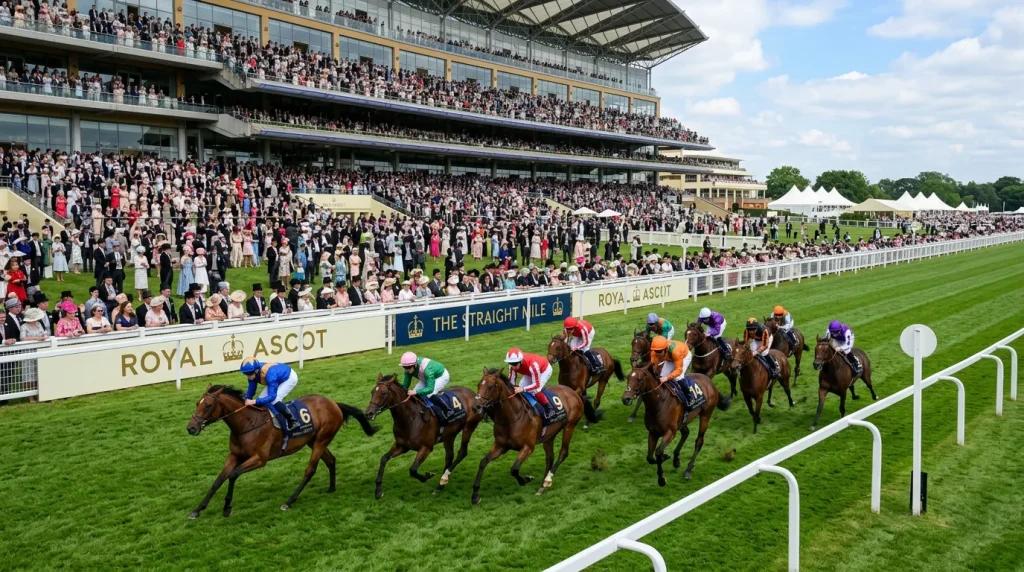
The meeting runs Tuesday through Saturday, with seven races each day. The programme blends Group 1 championship races, competitive Group 2 and 3 events, valuable listed races, and fiercely competitive handicaps. Each day features at least one race of genuine championship calibre alongside supporting cards that attract quality fields throughout.
Tuesday opens with the Queen Anne Stakes, a one-mile Group 1 that sets the tone for the week. The King’s Stand Stakes over five furlongs and the St James’s Palace Stakes for three-year-old milers complete Tuesday’s Group 1 contingent. Wednesday features the Prince of Wales’s Stakes over ten furlongs—often the race of the meeting—plus the Royal Hunt Cup, one of the week’s premier handicaps.
Thursday brings the Gold Cup, a two-and-a-half-mile staying test that represents the meeting’s blue riband event. Friday’s highlight is the Coronation Stakes for three-year-old fillies, while Saturday concludes proceedings with the Diamond Jubilee Stakes over six furlongs.
International participation shapes the betting landscape. American raiders target sprint races; French challengers contest middle-distance events; Australian and Hong Kong runners occasionally attempt the straight-track challenges. Assessing international form—how it translates to British conditions and Ascot’s specific characteristics—becomes essential for serious punters.
The handicaps deserve particular attention. The Royal Hunt Cup, Wokingham Stakes, and Britannia Stakes attract enormous fields of 20 to 30 runners, creating lottery conditions where place betting and exotic wagers offer genuine value. These races differ fundamentally from the championship events; different betting approaches apply.
Betting Group Races at Ascot
Group race betting at Royal Ascot rewards form analysis over speculation. At this level, horses have established form profiles; ability is proven rather than potential. The challenge shifts from identifying talent to assessing relative class and suitability for specific conditions.
Class levels matter precisely. A horse rated 115 attempting a Group 1 where typical winners rate 120+ faces a genuine ability deficit. Conversely, a 118-rated horse dropping from Group 1 company to a Group 3 might represent banker material—though the market typically reflects this, compressing prices to unappealing levels.
International form requires careful translation. American turf form offers guidance but the racing style differs: tighter turns, different pace profiles, varying ground conditions. European form from France and Ireland translates more directly, though course-specific factors still apply. Form from Dubai, Hong Kong, or Australia demands cautious interpretation—conditions vary significantly from British summer turf.
Course form at Ascot carries genuine predictive weight. The straight mile course, the round course with its uphill finish, and the different characteristics at various distances all influence outcomes. Horses that have won or performed well at Ascot previously have demonstrated course suitability; course newcomers introduce uncertainty.
Three-year-olds meeting older horses create intriguing dynamics in open Group races. The weight-for-age allowance compensates for physical immaturity, but the question of whether a specific three-year-old can handle seasoned rivals remains until answered. Some classic-generation horses prove exceptional; others are found wanting.
Market efficiency increases at Group level. Professional money flows heavily into these races; obvious value disappears quickly. Finding edge requires either identifying subtle factors the market underweights or accepting that bookmaker margins represent the cost of participation in efficiently-priced events.
Royal Ascot Handicaps
The Royal Hunt Cup typifies Ascot’s handicap challenge: 25+ runners over a straight mile, all theoretically equalised by weight, competing for significant prize money. The market struggles to separate contenders; implied probabilities spread thinly across the field. This creates opportunity—but also genuine difficulty.
Place betting suits these races better than win-only approaches. With a quarter of the field typically filling the places, backing horses each-way captures value when genuine contenders finish second through sixth without winning. The place portion provides insurance; the win portion offers upside when everything aligns.
Draw analysis becomes critical on the straight course. Depending on ground conditions and race distance, different stalls offer advantages. A horse drawn poorly might be effectively eliminated before the race begins; one drawn ideally gains ground without effort. Studying draw statistics for specific conditions—and adjusting selections accordingly—improves outcomes.
Progressive handicappers often outperform their official marks. Horses improving through the season, recently raised by the handicapper but potentially still ahead of the assessor, offer value when the market hasn’t fully priced their trajectory. Conversely, exposed handicappers whose form has plateaued rarely find enough to win competitive Royal Ascot fields.
The Wokingham over six furlongs presents similar challenges: massive field, compressed odds, draw significance. The Britannia Stakes for three-year-olds adds another dimension—horses still developing, ratings potentially behind improvement. Each handicap requires specific analysis rather than generic approaches.
Exotic betting—Tote Exactas, Trifectas, Placepots—offers genuine value in these unpredictable races. When the dividend for picking first and second exceeds what straight betting would deliver, exotic bets become mathematically attractive. Large-field handicaps produce exactly these dividend conditions.
The Ground Factor at Ascot
Ascot’s ground conditions vary substantially during the week and across meetings. The track management team aims for good to firm ground, but June weather can push conditions either way. Heavy rain produces soft going that transforms the characteristics of every race; drought brings firm ground that favours different types.
Ground preferences matter enormously. Horses that thrive on fast ground struggle when conditions ease; confirmed soft-ground specialists find their optimum rarely arrives at Royal Ascot. Identifying horses whose preferences match likely conditions—and adjusting when conditions change—provides genuine edge.
The draw on the straight course interacts with ground conditions. When ground varies across the track—faster stands’ side, slower far side, or vice versa—draw becomes even more significant. Late withdrawals and stable placement can shift optimal racing positions. Following live ground reports and draw analysis through the week keeps your assessments current.
Watering policies attempt to produce consistent ground, but cannot fully control conditions. Understanding what the track is trying to achieve—and how weather might override those intentions—helps anticipate the conditions your selections will face.
The uphill finish on Ascot’s round course suits strong stayers and horses that handle testing conditions. What looks like a good position turning in can evaporate on the climb; front-runners without genuine stamina reserves get caught. Assessing finishing ability over the Ascot straight—separate from pure speed—adds a dimension to round-course race analysis.
Temperature and humidity affect horse performance in ways that ground descriptions don’t capture. Hot, humid June days can dull performance for horses that prefer cooler conditions; fresh weather sharpens others. While impossible to quantify precisely, awareness of these factors complements formal ground assessment.
Royal Ascot rewards preparation, discipline, and respect for the quality of competition. The meeting’s prestige attracts the best horses and the sharpest betting market—success requires matching that standard with your analysis.
For detailed guidance on how ground conditions affect betting decisions, see our comprehensive going and ground guide. And for understanding draw biases that influence straight-course races, our draw bias analysis provides the statistical framework.