Starting Price vs Early Odds: Which Should You Take?
Best Horse Racing Betting Sites – Bet on Horse Racing in 2026
Loading...
Starting Price (SP) or the morning price—the decision that can make or break your bet arrives before the horse even enters the stalls. Every punter faces this dilemma: take the price you see now, or wait for the Starting Price and hope it moves in your direction. Get it right and you’ve squeezed extra value from a winner. Get it wrong and you’ve either watched good odds drift away or locked in a price that shortens dramatically by race time.
Neither approach is universally correct. The right choice depends on the specific horse, the race conditions, and your assessment of how the market will move. Some horses reliably shorten as money pours on nearer the off; others drift as early confidence evaporates. Knowing which is which—or at least making an educated guess—separates punters who consistently extract value from those who leave money on the table.
This guide explains how SP is determined, examines when taking early prices offers an edge, identifies scenarios where waiting for SP proves shrewd, and provides a framework for making this decision on any race you’re considering.
What Is Starting Price (SP)?
The Starting Price is the official industry price returned on a horse at the moment the race begins. It’s not a single bookmaker’s assessment but a consensus derived from on-course bookmakers’ boards at racecourses throughout Britain and Ireland.
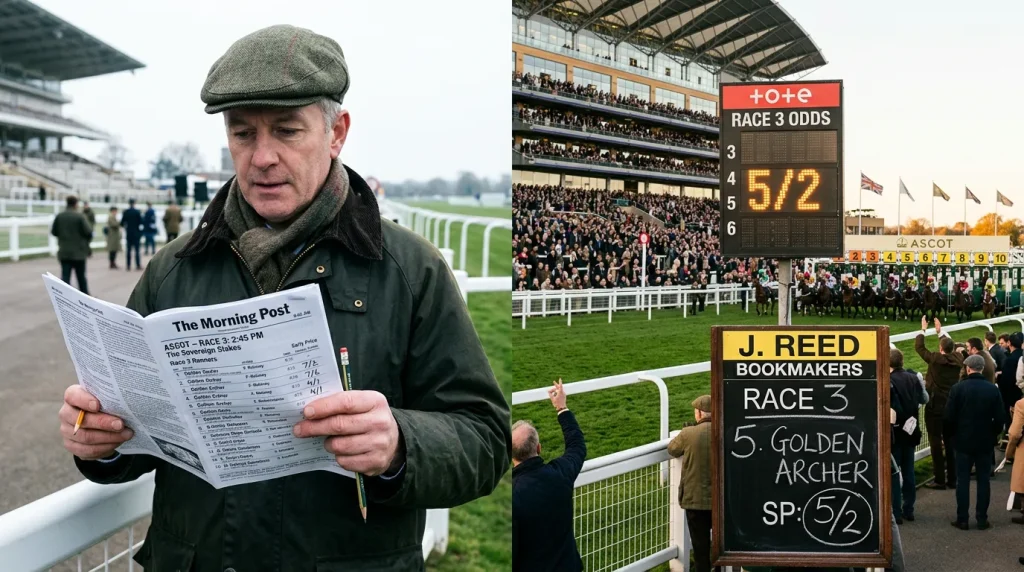
Here’s how it works. In the minutes before a race, bookmakers in the betting ring at the racecourse display their odds on traditional boards. These prices fluctuate as money comes for different horses. At the precise moment the race starts—the “off”—independent officials from the Starting Price Regulatory Commission record the prices showing on designated bookmakers’ boards. The SP is then calculated as a representative price from these recorded odds.
This system exists because SP has legal and regulatory significance. It determines payouts for bets placed at “SP” and provides a benchmark when disputes arise about what odds should have been paid. The process is designed to be transparent and independent of any single betting operator’s interests.
For punters, SP represents the final judgment of the on-course market. It incorporates all the information and money that has flowed through the betting ring in the build-up to the race. Late money from professionals, significant gambles from stables, last-minute jockey changes—all of this influences where the SP settles.
The relationship between morning prices and SP varies dramatically. A horse might open at 10/1 in the morning and return an SP of 5/1 if money pours on throughout the day. Conversely, it might drift from 5/1 to 10/1 if support fails to materialise. Analysis of Betfair Starting Price (BSP) versus traditional SP across a racing season found notable differences in profitability: one study showed a gain of +191 points backing at BSP compared to +69 points at traditional SP over the same selections. The exchange price, unencumbered by the margin on-course bookmakers build in, often delivers better value—but the principle remains: timing your bet matters.
Understanding SP’s formation helps you anticipate movement. Heavy early support typically means SP will be shorter than the morning price. Lack of support, or negative whispers from stables, often leads to drift. The challenge is reading these signals before they become obvious.
The Case for Taking Early Prices
Certain horses shorten relentlessly. You see it play out race after race: a horse opens at 8/1 in the morning, stands at 6/1 by lunchtime, and returns an SP of 9/2. If you believed in that horse and took 8/1, you’ve extracted nearly double the value of someone who took SP. That’s the core argument for grabbing early prices—capturing value before the market corrects.
Horses from powerful stables often attract late support. When a trainer with a reputation for placing horses to win targets a specific race, the betting market frequently takes notice closer to post time. The morning price represents uncertainty; the SP reflects accumulated confidence from those watching the money flow. Similarly, horses returning from a layoff with an obvious fitness target can shorten dramatically as positive reports emerge from the gallops.
Jockey bookings influence movement too. When a leading rider takes a spare ride on a horse that wasn’t initially engaging attention, market watchers notice. The booking signals intent. By the time most punters react, the price has already contracted.
Then there’s Best Odds Guaranteed—a promotion that eliminates the downside risk of taking early prices. Most major UK bookmakers offer BOG on British and Irish horse racing: you take the morning price, and if the SP is higher, you’re paid at SP instead. You can’t lose by taking early. This transforms the decision calculus entirely. With BOG, there’s no rational reason to take SP on a horse you believe will shorten. You either get your early price or you get something better.
The exception is when BOG doesn’t apply—certain races, certain times, certain bookmakers have restrictions. Always check the terms. And not all bookmakers offer BOG equally generously; some cap the enhanced payout or exclude certain markets. Knowing your bookmaker’s specific terms prevents unpleasant surprises.
For punters who do their form study thoroughly, taking early prices becomes a competitive advantage. Your analysis is complete when the morning prices appear. Waiting for SP means allowing others to benefit from the same conclusions you’ve already reached.
When SP Works in Your Favour
Not every horse shortens. Some drift—and when they do, taking SP delivers a bigger price than any morning offer.
Horses that attract early support from tipsters but lack genuine backing from insiders often drift. The morning price reflects public enthusiasm; the SP reflects what the serious money thinks. When those assessments diverge, the smart money usually wins. If you’re contrarian by nature—backing horses the market doesn’t fully trust—SP might consistently deliver better value than prices inflated by newspaper selections.
Lightly raced horses present particular uncertainty. The market can’t price them with confidence because there’s limited evidence to assess. Morning prices are often guesswork. By race time, paddock inspections, market whispers, and betting patterns have filled some gaps. Occasionally this works against you. More often, the afternoon reveals doubts that weren’t visible at breakfast. If you’ve identified a lightly raced horse you think is vulnerable to drift, taking SP captures the market’s revised pessimism.
Weather-dependent selections benefit from waiting when conditions are uncertain. A horse who needs soft ground might open at reasonable odds before the forecast clarifies. If the rain fails to arrive and the ground dries, support evaporates and the horse drifts. If you anticipated this possibility, waiting for SP protects you from locking in a price that no longer reflects reality. Of course, if the rain does arrive, you’ve forfeited the early value—SP cuts both ways.
Larger fields with multiple plausible winners sometimes see favourites drift. Early money spreads across several contenders; none emerges dominant. The market can’t settle on a clear leader. In these races, betting early on any selection risks taking a price that expands as competition for favouritism remains unresolved. The SP of your selection might be significantly longer than the morning offer if another horse attracts the late support instead.
The honest answer is that predicting drift is difficult. Unlike shorteners—where you can often spot the pattern in trainer intent, jockey bookings, and stable confidence—drifters reveal themselves through absence of support. That’s harder to anticipate. Most successful punters default to taking early prices with BOG protection and accept that occasional drifters represent an unavoidable cost.
Making the Decision
A working framework for the SP-versus-early-price decision involves three questions.
First: does BOG apply? If it does, take the early price unless you specifically believe the horse will drift. With BOG protection, you’re guaranteed the best of both worlds on shorteners and neutral on drifters. The mathematics favour early action.
Second: what’s the profile of this horse? A well-backed selection from a top stable returning from a break with an obvious target is a likely shortener. A tip-driven selection without insider support is a potential drifter. A lightly raced horse entering a competitive handicap could go either way. Your form study should generate a view on where the market is likely to move.
Third: how confident is your assessment relative to the market’s? If you believe a horse’s chances are better than the morning price implies, take that price. You’ve identified value; waiting risks watching it evaporate. If your confidence matches the market’s assessment, the timing matters less—you’re agreeing with the crowd, not finding an edge.
Over time, tracking your results illuminates patterns. Some punters consistently do better with early prices; others find SP serves them well. Your particular approach to selection—whether you favour obvious contenders or market-neglected runners—influences which timing strategy suits your style.
The timing of your bet is a variable you control. Understanding when to lock in value and when to let the market settle represents an edge that compounds across hundreds of wagers.
For comprehensive coverage of Best Odds Guaranteed—including which bookmakers offer it and how to maximise its value—see our detailed BOG guide. And for the form analysis skills that let you anticipate market movement, our guide to reading horse racing form provides the methodology behind confident selection.