
Tote Betting Explained: Pool Betting vs Fixed Odds
Best Horse Racing Betting Sites – Bet on Horse Racing in 2026
Loading...
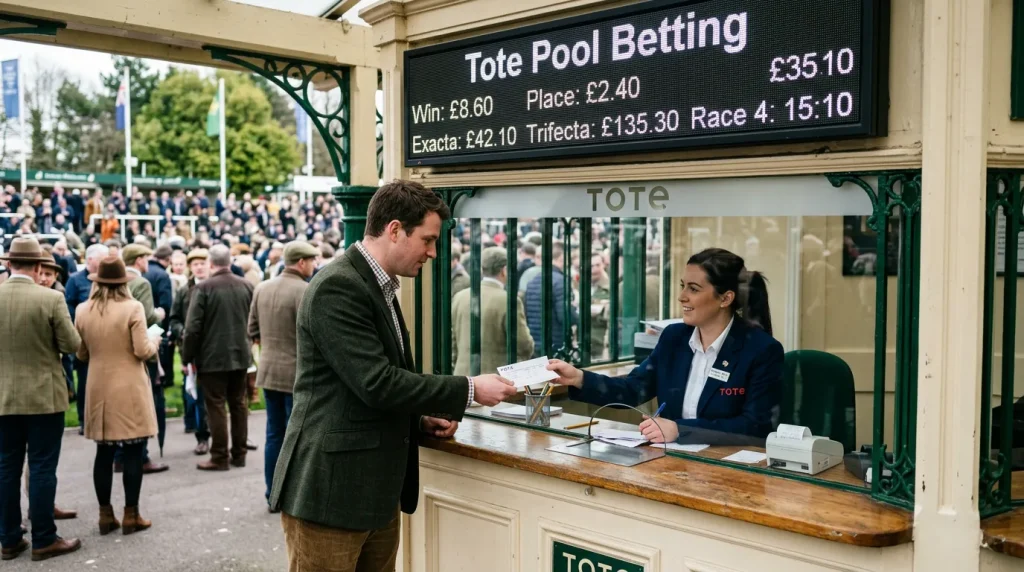
Tote betting vs bookmaker odds presents a fundamental choice in how you wager on horse racing. With a bookmaker, you accept fixed odds at the moment you place your bet. With the Tote, you’re betting into a shared pool rather than against the bookie—your return depends on how much money ends up on your selection relative to the total pool.
Pool betting predates fixed-odds bookmaking. The totalisator system, from which “Tote” derives its name, was the original mechanised betting method. Punters put money in; the operator takes a percentage; the rest is divided among winning tickets. The principle remains unchanged, even as the technology has evolved from mechanical calculators to digital platforms.
Neither system is inherently superior. Fixed odds offer certainty: you know what you’ll win before the race runs. Pool betting offers potential: on the right selections, particularly outsiders in large pools, the dividend can dramatically exceed bookmaker odds. Understanding when each system favours the punter turns a choice between two options into a strategic decision.
How Pool Betting Works
The pool concept is straightforward. Every punter betting on a race contributes their stake to a shared pool. The Tote operator deducts a percentage—typically between 13% and 30% depending on the bet type—and the remaining money is divided among winning bets proportionally.
Consider a simplified example. A Win pool totals £10,000. After the operator takes 16%, £8,400 remains for distribution. If £840 was staked on the winning horse, each £1 bet returns £10 (£8,400 ÷ £840). That’s a dividend of £10 to a £1 stake, roughly equivalent to 9/1 in bookmaker odds.
The crucial difference from fixed odds is timing. With a bookmaker, your odds are locked the moment you bet. With pool betting, your return depends on the final pool composition at race time. Heavy late money on your selection reduces your dividend; unexpected support for other horses increases it. You never know the exact return until the race has finished and the dividend is declared.
Pool sizes vary enormously. Major festivals generate huge pools: Cheltenham Festival 2026 saw record Tote pool turnover of £11.34 million, with over 570,000 individual bets placed across the week. These large pools tend to produce dividends closer to bookmaker SP—the weight of money smooths out irregularities. Smaller meetings with thinner pools can produce dramatic dividends when lightly-backed horses win, but they can also produce disappointing returns when an outsider attracts disproportionate pool support.
The Tote displays estimated dividends as betting progresses, updated regularly in the lead-up to races. These projections help you gauge whether pool betting might offer value compared to available fixed odds. But they’re estimates, not guarantees—late money can shift them significantly.
Tote Bet Types
The Tote offers several distinct bet types, each with its own pool and takeout percentage.
Tote Win operates like a standard win bet: your horse must finish first. The pool typically has the lowest takeout, making it the closest equivalent to fixed-odds win betting. Dividends on favourites usually approximate bookmaker SP; dividends on outsiders can exceed or fall short depending on pool composition.
Tote Place requires your selection to finish in the places—typically first, second, or third, though this varies by field size. Place pools have higher takeouts than Win pools, and dividends can diverge significantly from bookmaker each-way place terms. Sometimes they’re generous; sometimes disappointing.
Exacta requires you to predict the first and second finishers in correct order. This forecast bet generates substantial dividends when outsiders fill the places, but the higher difficulty means many Exacta bets fail. The permutation option lets you cover multiple combinations at increased stake cost.
Trifecta extends the forecast concept to three places: first, second, and third in correct order. The difficulty—and potential rewards—increase accordingly. Trifecta dividends on unpredictable races regularly run to four figures.
Placepot is the Tote’s most popular exotic bet. You must find a placed horse in each of the first six races at a meeting. You don’t need winners; place finishes suffice. The cumulative difficulty of six successful selections produces substantial dividends when fewer punters navigate the card successfully. Placepot permits multiple selections per race at proportionally increased cost.
Jackpot requires picking the winner of all six nominated Jackpot races—a demanding task that produces enormous dividends when achieved. Rollover jackpots accumulate when no one selects all six winners, creating occasional pools worth hundreds of thousands of pounds.
Quadpot mirrors the Placepot concept but covers only the final four races of a meeting. It’s more accessible, with lower entry cost and difficulty, but correspondingly smaller dividends.
Comparing Tote and Fixed Odds
The fundamental trade-off is certainty versus potential. Fixed odds tell you exactly what you’ll win; pool betting keeps you guessing until the dividend is declared.
Fixed odds favour value-conscious punters who want to lock in prices they’ve identified as generous. If you believe a horse should be 5/1 and the bookmaker offers 7/1, you can capture that edge immediately. With pool betting, the dividend might settle above or below your assessment—the outcome depends partly on what other punters do.
Pool betting can favour backing outsiders. In fixed-odds markets, bookmakers build larger margins into longshot prices, knowing recreational punters overbet unlikely winners. Pools have no such adjustable margin; the operator takes a fixed percentage regardless of which horse wins. When a genuine outsider wins a big pool, the dividend often exceeds bookmaker SP because lightly-backed horses receive disproportionate shares of the pool.
Conversely, backing heavily-supported favourites in pools typically delivers inferior value. The weight of money on obvious contenders compresses their dividends below bookmaker SP. You’re effectively paying for certainty you could have obtained more cheaply with fixed odds.
Exotic bets—Exactas, Trifectas, Placepots—offer genuine value opportunities. Bookmaker versions of these bets carry steep margins. The Tote’s pooled approach means dividends can be more generous when results confound expectations. A Trifecta landing three unconsidered horses pays far better through the pool than any combination bookmaker forecast.
The Best Odds Guaranteed promotion tilts the calculus for standard Win and Place betting. When BOG applies, fixed odds with bookmakers dominate: you capture value on shorteners while being protected on drifters. The Tote offers no equivalent protection, so BOG-eligible races generally favour bookmaker betting for straightforward win bets.
Strategic Tote Betting
Identifying overlays—situations where pool dividends likely exceed fair value—represents the core Tote strategy. This happens when your assessment of a horse’s chances exceeds market perception, and pool composition amplifies the discrepancy.
On major festival days with large pools, Tote dividends track bookmaker SP closely. Strategic opportunities are limited; you’re essentially getting market prices with less certainty. Save Tote Win and Place betting for smaller meetings where pools are thinner and irregularities more common.
Placepot strategy rewards systematic thinking. Six placed finishes across an afternoon is achievable, but each leg requires balancing coverage (more selections, lower returns) against conviction (fewer selections, higher risk). Many successful Placepot punters adopt a structured approach: single selections in races where they have strong views, multiple selections where uncertainty is higher.
The banker concept applies powerfully to Placepots. Singling a strong selection in one race while permutating others keeps stake costs manageable while concentrating value on your best assessment. The danger is banking a loser—one failed banker and your entire Placepot stake is gone.
Trifecta and Exacta betting suits races with predictable principals but uncertain minor placings. If you’re confident the favourite will win but less sure who’ll fill second and third, coverage permutations can capture value. The key is ensuring potential dividends justify the permutation cost.
Pool betting offers a genuine alternative to fixed-odds wagering—not better or worse, but different in ways that create strategic opportunities. Understanding when the Tote favours punters expands your betting options beyond the bookmaker market.
For the biggest pools of the year, including Placepot opportunities with substantial dividends, see our guide to Grand National betting where pool participation reaches peak levels. And for the broader context of comparing betting approaches, our pillar guide covers the complete landscape of horse racing betting odds.