Betting Exchanges vs Traditional Bookmakers: Complete Comparison
Best Horse Racing Betting Sites – Bet on Horse Racing in 2026
Loading...
Betting exchange horse racing represents a fundamentally different model from traditional bookmakers—one where you’re betting against other punters instead of the bookie. Since Betfair launched in 2000, exchanges have transformed how serious punters approach horse racing markets. The concept is simple: rather than accepting odds set by a bookmaker, you match bets with other punters who hold opposing views. Someone thinks the horse will win; someone else thinks it won’t. The exchange facilitates the transaction and takes a commission.
This peer-to-peer model creates opportunities that traditional bookmakers simply cannot offer. Better odds on many races, because there’s no bookmaker margin built into every price. The ability to lay horses—betting against them winning—which opens entirely new strategic possibilities. Live trading during races as prices shift in real time. For punters who understand the mechanics, exchanges provide tools that can significantly improve returns compared to bookmaker-only betting.
But exchanges aren’t universally superior. They require understanding concepts like liquidity, liability, and commission that don’t apply at traditional bookmakers. The best odds mean nothing if there’s no money available to match your bet. Laying carries risk that backing doesn’t. And commission on winnings, while typically lower than bookmaker margins on competitive races, can erode your edge on smaller markets.
What follows is the complete guide to exchange betting for horse racing. We’ll examine how the exchange model differs from traditional bookmakers, explain the mechanics of backing and laying, break down commission structures and their impact on returns, address the critical importance of liquidity, and provide practical guidance on when to use exchanges versus bookmakers. By the end, you’ll understand whether exchange betting suits your approach—and how to use it effectively if it does.
How Exchanges Differ from Traditional Bookmakers
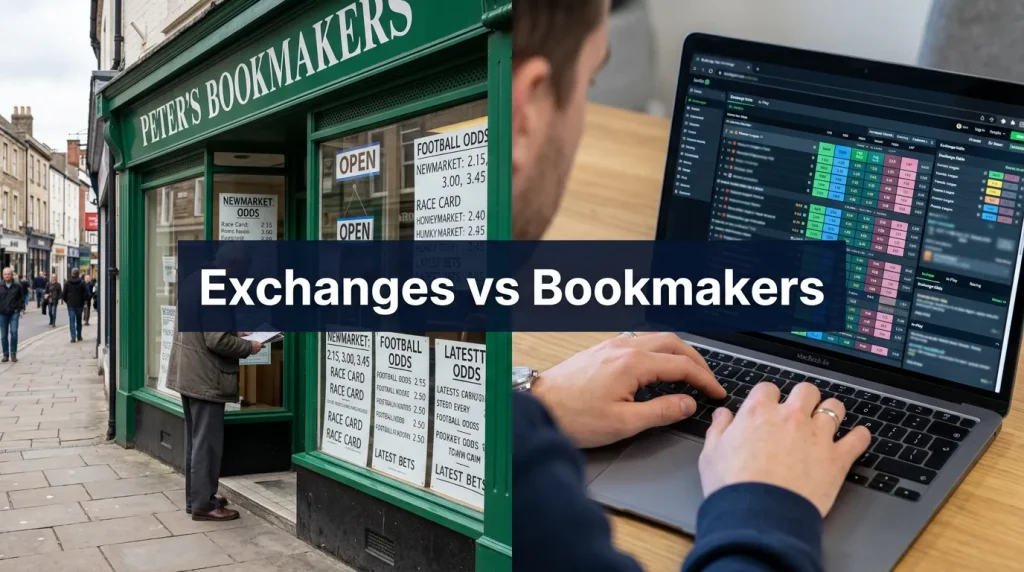
The difference between bookmakers and exchanges is structural, not just cosmetic. A traditional bookmaker sets odds, accepts your bet, and pays you if you win. The bookmaker is your counterparty—they lose when you win, and vice versa. This creates an inherent conflict of interest. Bookmakers protect themselves by building margin into their odds (the overround) and, increasingly, by restricting or closing accounts of consistently winning punters.
An exchange operates differently. Betfair, Betdaq, Smarkets, and other exchanges don’t set odds at all. They provide a marketplace where punters with opposing views find each other. If you want to back a horse at 5.0, you need another punter willing to lay that horse at 5.0. The exchange facilitates the match, holds the money, and pays the winner—taking a commission for the service. The exchange profits regardless of which horse wins, so it has no reason to restrict winning punters.
This model typically produces better odds because there’s no systematic overround. On a traditional bookmaker market, the implied probabilities of all runners sum to 105-115 per cent—the excess is margin. On an exchange, that figure often sits below 102 per cent because the prices reflect genuine market opinion without embedded profit. The difference matters. On a 5/1 shot, a bookmaker might offer 5.0 while the exchange shows 5.4. That’s an 8 per cent improvement in potential return.
The shift towards online betting has made exchanges increasingly accessible. Research from the Social Market Foundation found that remote gambling grew from approximately 15 per cent of the UK market in 2012 to around 60 per cent by 2026. This migration online has normalised exchange use—punters who once visited betting shops now routinely compare bookmaker and exchange prices on their phones.
Betfair dominates the UK exchange market by a significant margin, offering by far the deepest liquidity across horse racing markets. Betdaq provides a credible alternative with lower commission rates. Smarkets positions itself as the low-commission option with a clean interface. Each exchange has strengths, but for UK horse racing, Betfair’s liquidity makes it the default choice for most serious punters—prices don’t matter if you can’t get matched.
One crucial distinction: exchanges require you to have funds available before betting. Unlike bookmakers, who extend credit in the sense that you only pay if you lose, exchanges hold your stake (for backs) or your liability (for lays) in escrow until the market settles. This protects all parties but means you need cleared funds in your exchange account before betting.
How Betting Exchanges Work: Backing and Laying
Exchange betting introduces a concept that doesn’t exist with traditional bookmakers: laying. Understanding both backing and laying is essential to using exchanges effectively.
Backing on an exchange works almost identically to betting with a bookmaker. You select a horse, choose your stake, and accept available odds. If the horse wins, you receive your winnings minus commission. If it loses, you forfeit your stake. The mechanics are familiar. The difference is that you’re being matched against another punter who’s laying the horse, not against a bookmaker’s book.
Laying is the opposite position: you’re betting that a horse won’t win. When you lay a horse, you’re effectively acting as the bookmaker for that specific bet. If the horse loses, you keep the backer’s stake (minus commission). If the horse wins, you pay out at the odds you offered. This introduces the concept of liability—the amount you stand to lose if the horse wins.
Liability calculations trip up beginners. If you lay a horse at 5.0 for a £10 stake, you’re accepting a bet where someone stakes £10 to win £40 profit. Your liability is that £40—the amount you’d pay if the horse wins. Your potential profit if the horse loses is £10 (the backer’s stake, minus commission). The lay stake displayed on exchanges is what you stand to win, not what you risk. Check liability carefully before confirming any lay bet.
The exchange order book shows available prices and amounts. The “back” column shows odds at which you can back immediately (with money waiting to be matched). The “lay” column shows odds at which you can lay immediately. The gap between best back and best lay prices is the spread—tighter spreads indicate a more liquid, efficient market. You can also request your own price: offer to back at higher odds or lay at lower odds than currently available, and wait to see if someone matches you.
Research published through arXiv analysing Betfair markets found approximately 1,056,766 price signals across 73 markets, with data updating as frequently as every 50 milliseconds during active trading. The same research showed an average of 9.86 participants per race, with new bets matching roughly every 50 seconds. These figures illustrate the dynamic nature of exchange markets—prices move constantly as information flows and opinions shift.
“Betting exchanges show remarkably high level of informational efficiency in returns,” the academic analysis notes, “in contrast to financial assets characterized by heavy tails and volatility clustering.” In practical terms, this means exchange prices rapidly incorporate available information. By the time a race starts, exchange odds typically represent a sophisticated consensus view of each horse’s chances.
Partial matching occurs when your bet is only partly filled at your requested odds. If you try to back £100 at 5.0 but only £60 is available at that price, you’ll be matched for £60 and the remaining £40 stays as an unmatched bet—either waiting for someone to take it or cancellable at your discretion. Monitoring your unmatched bets matters; forgetting about them can lead to surprises.
Exchange Commission: What You Actually Pay
Exchange commission works differently from bookmaker margin. Bookmakers build their profit into every price through overround—you pay whether you win or lose. Exchanges charge commission only on winning bets, as a percentage of your net profit. This distinction has significant implications for how you should think about exchange betting.
Betfair’s commission structure now offers flexibility through their My Betfair Rewards programme. The standard “Rewards” package charges 5 per cent of net winnings, while the “Basic” package reduces this to just 2 per cent. If you back a horse at 4.0 with a £10 stake and win at 5 per cent, your gross profit is £30 and commission takes £1.50, leaving £28.50 net. At 2 per cent, you’d keep £29.40 instead. If you lose, you pay no commission—just your lost stake. This structure means commission only bites when you’re winning, which feels gentler than embedded margin but still accumulates significantly over time.
The trade-off for Betfair’s 2 per cent rate is losing access to certain sportsbook promotions and offers. For punters focused purely on exchange betting—particularly matched bettors or regular traders—the Basic package with 2 per cent commission typically makes sense. Those who also use Betfair’s sportsbook might find value in the higher-commission packages’ promotional benefits.
Competitors offer comparable rates. Betdaq charges 2 per cent commission on most horse racing markets. Smarkets similarly advertises a flat 2 per cent rate (rising to 3 per cent only for the most profitable users exceeding £25,000 annual profit). These rates match Betfair’s Basic tier, but liquidity remains the critical differentiator. For major UK races, Betfair’s deeper markets often outweigh marginal commission differences; for smaller markets where all exchanges struggle for liquidity, the choice becomes less clear.
When comparing exchange prices to bookmaker odds, commission adjustment is essential. If a bookmaker offers 5.0 and Betfair shows 5.3 at 5 per cent commission, the effective exchange price is 5.3 × 0.95 = 5.035—marginally better than the bookmaker but not the dramatic improvement the raw price suggests. For the exchange to clearly beat the bookmaker after commission, the price difference needs to exceed your commission rate.
Commission also affects lay betting calculations. When you lay a horse and the backer loses, you keep their stake minus commission. At 5 per cent, keeping a £10 stake means receiving £9.50, not £10. This matters for strategies like matched betting where precision calculations determine profit.
One nuance: Betfair calculates commission on net market profit, not individual bets. If you back one horse and lay another in the same race, your commission applies only to your net winnings across the whole market. This aggregation benefits punters who trade or hold multiple positions, but complicates the mental arithmetic of calculating effective prices.
Understanding Liquidity: Why It Matters for Your Bets
Liquidity is the amount of money available to match at various price points. High liquidity means you can get significant amounts matched quickly at competitive prices. Low liquidity means you might struggle to find counterparties, accept worse prices, or get only partially matched. For exchange betting, liquidity is everything.
Major race days generate substantial liquidity. Cheltenham Festival, the Grand National meeting, Royal Ascot, and big Saturday cards attract enormous betting volumes. The expected £450 million in betting turnover for the 2026 Cheltenham Festival, projected by William Hill, illustrates the scale of wagering on premium events. A healthy portion of this flows through exchanges, creating deep markets where large bets can be matched at tight spreads.
Conversely, midweek racing at minor tracks generates far less exchange activity. You might see a Monday afternoon race at Plumpton with only a few thousand pounds matched across the entire market. Trying to stake £500 on a 12/1 shot in such a market may prove difficult—the money simply isn’t there to match you. You’ll either accept worse odds, get partially matched, or leave your bet unmatched entirely.
Liquidity builds as post time approaches. Ante-post markets (weeks or months before a race) show thin liquidity and wide spreads. Day-of-race markets improve significantly. The final minutes before the off see the heaviest trading, as in-running markets approach and late money floods in. If you want the best chance of getting matched at competitive prices, betting in the 30 minutes before the race typically offers optimal conditions.
The in-play or in-running market opens once the race starts. Prices swing dramatically as the race unfolds—a leader fading, a challenger making ground, an incident at a fence. Liquidity in-play varies enormously by race. The Grand National in-running market is among the most active sporting markets globally; an ordinary selling hurdle might have minimal in-play activity. Trading in-play requires quick reactions and an understanding of how prices move.
Low liquidity creates specific problems beyond simply not getting matched. Thin markets exhibit wider spreads between back and lay prices, reducing value. They’re also more susceptible to manipulation—a single large bet can move prices significantly. And they make trading difficult, as exiting a position requires finding someone to take the other side.
For most punters, the practical advice is straightforward: use exchanges for major races where liquidity is deep and prices are competitive. Use bookmakers (or accept exchange limitations) for smaller events where liquidity constraints may negate the theoretical price advantage.
Certain race types attract better exchange liquidity than others. UK and Irish racing generates far more exchange activity than French, German, or American racing. Flat handicaps often see better liquidity than equivalent jumps races. Races broadcast on terrestrial television draw more exchange money than those hidden on streaming services. These patterns help predict where exchange betting will offer genuine value versus theoretical-only advantages.
Learning to read exchange depth takes practice. The displayed amounts at each price point indicate how much money you could get matched immediately. But those amounts change constantly—money gets matched, new orders arrive, prices shift. Experienced exchange users develop intuition for market depth, recognising when displayed liquidity is robust versus when it might evaporate under pressure. This market-reading skill, while difficult to teach in writing, develops naturally through active exchange use.
When to Use Exchanges vs Bookmakers
The choice between exchange and bookmaker isn’t binary—serious punters use both, selecting the optimal platform for each situation. Understanding when each excels helps maximise returns.
Use bookmakers when: Best Odds Guaranteed (BOG) applies. Many bookmakers offer to pay at Starting Price if it exceeds the odds you took. This free insurance against price drift doesn’t exist on exchanges. If you back a horse early at 5/1 and it drifts to 8/1 by the off, a BOG bookmaker pays 8/1; an exchange pays whatever price you locked in. For ante-post markets and situations where you’re taking early prices, BOG offers valuable downside protection.
Use bookmakers when: promotional offers add value. Free bets, enhanced odds, money-back specials, and place promotions create additional expected value that exchanges can’t match. These offers often favour recreational betting patterns, but they exist and shouldn’t be ignored. A “bet £10 get £10 free bet” offer effectively doubles your first bet’s expected value if used strategically.
Use bookmakers when: Rule 4 protection matters. In ante-post markets, bookmakers typically apply Rule 4 deductions if a horse withdraws, reducing your potential return but maintaining your bet on the remaining field. Exchanges don’t offer equivalent protection—if your horse is withdrawn, your bet is void and returned. For big-race ante-post betting where withdrawals are common (think Champion Hurdle or Derby markets), bookmaker Rule 4 terms may prove preferable to exchange void-on-withdrawal rules.
Use exchanges when: you want the best price on competitive races. For feature races at major meetings, exchange prices frequently beat bookmaker odds after commission. The competition among informed punters drives prices towards true probability more efficiently than bookmaker price-setting. Check both, but expect exchanges to offer better value on high-profile handicaps, Group races, and well-covered events.
Use exchanges when: you want to lay a horse. Traditional bookmakers don’t let you bet against a horse—only for it. If you’ve identified an over-bet favourite or a horse whose price doesn’t reflect its true (low) chances, laying on an exchange lets you profit from that view. This opens strategic possibilities unavailable through bookmakers alone.
Use exchanges when: account restrictions become an issue. Bookmakers routinely restrict or close accounts of consistently profitable punters. Exchanges don’t—they profit from commission regardless of which side wins. If your bookmaker accounts are limited or closed, exchanges remain open. For this reason alone, many winning punters transition primarily to exchange betting over time.
Use exchanges when: trading appeals to you. Trading involves backing and laying the same horse at different prices to lock in profit regardless of outcome. This requires understanding of price movements, timing, and risk management. Exchanges make trading possible; bookmakers don’t. If you’re interested in a more active, market-oriented approach to betting, exchanges provide the necessary infrastructure.
Use exchanges when: you need to exit a position before the race. If you’ve backed a horse at 4.0 and subsequent news (jockey change, ground concerns, negative market moves) makes you doubt your selection, exchanges let you lay the same horse to cut your exposure. Bookmakers offer cash-out features, but typically at unfavourable rates. On exchanges, you’re trading at market prices with transparent commission, giving you more control over position management.
The question of Betfair Starting Price (BSP) versus traditional Starting Price deserves mention. BSP is calculated from the exchange order book at the moment the race begins—a weighted average of unmatched bets. It often differs from traditional SP, sometimes favourably. Many systematic bettors use BSP for runners they believe will drift (improve in price), avoiding the need to monitor markets pre-race while still capturing exchange efficiency. BSP carries the standard commission rate, but removes the risk of being unmatched on your preferred price.
The pragmatic approach combines both platforms. Check bookmaker offers and BOG terms for ante-post and early-day betting. Compare exchange prices before major races. Use exchanges for laying and trading. Maintain multiple bookmaker accounts (before they restrict you) while building exchange expertise. This hybrid strategy extracts value from both models.
Consider your betting volume when choosing platforms. Low-volume recreational punters might find bookmaker simplicity and promotional offers more valuable than marginally better exchange prices. High-volume serious punters almost certainly benefit from exchange access—the compounding effect of better prices across hundreds of bets significantly impacts returns. Somewhere between casual and professional lies a threshold where exchange learning becomes worthwhile; only you can judge where you sit on that spectrum.
The learning curve for exchange betting is real but manageable. Start with backing only—it’s identical to bookmaker betting except for commission. Graduate to simple lay bets on horses you’re confident will lose. Only then consider trading or more complex strategies. Most punters who abandon exchanges do so because they tried advanced techniques before mastering basics. Take it step by step, and the additional tools exchanges provide become natural extensions of your betting approach.
Betting exchanges represent a genuine innovation in how racing markets function. They’ve pushed bookmakers towards tighter pricing, given punters more options, and created opportunities for sophisticated strategies that didn’t exist a generation ago. Whether they suit your betting style depends on your volume, your willingness to learn the mechanics, and the types of races you target. For many serious punters, exchanges become indispensable once understood—a tool in the arsenal that traditional bookmakers alone cannot replace.